Please note that on our website, we use cookies. They are necessary for the functioning of our website and optimizing its performance. By clicking "Allow Cookies," you agree to our cookie policy. Learn
More
Available Now
(24/7, toll-free)
Looking for personalized itineraries or have questions about our services? We're here to
help.
What It's Really Like Flying Business Class to Australia
April 2, 20268 min Read Last updated on April 27, 2026
Business Class, Premium Destinations
A door-to-door breakdown seat selection, sleep strategy, meal timing, lounge access, and which airlines actually deliver on a 20+ hour journey.
Route length: 14–22 hrs flight time
Avg price: $3,800–$9,500 return
Best stops: Singapore · Dubai · Doha · Hong Kong
No flight to Australia is "short", so your seat matters more than anything
Most routes require at least one connection, putting you in the air for anywhere between 14 and 22 hours total. A flat-bed seat isn't a luxury here; it's the difference between arriving functional and arriving wrecked.
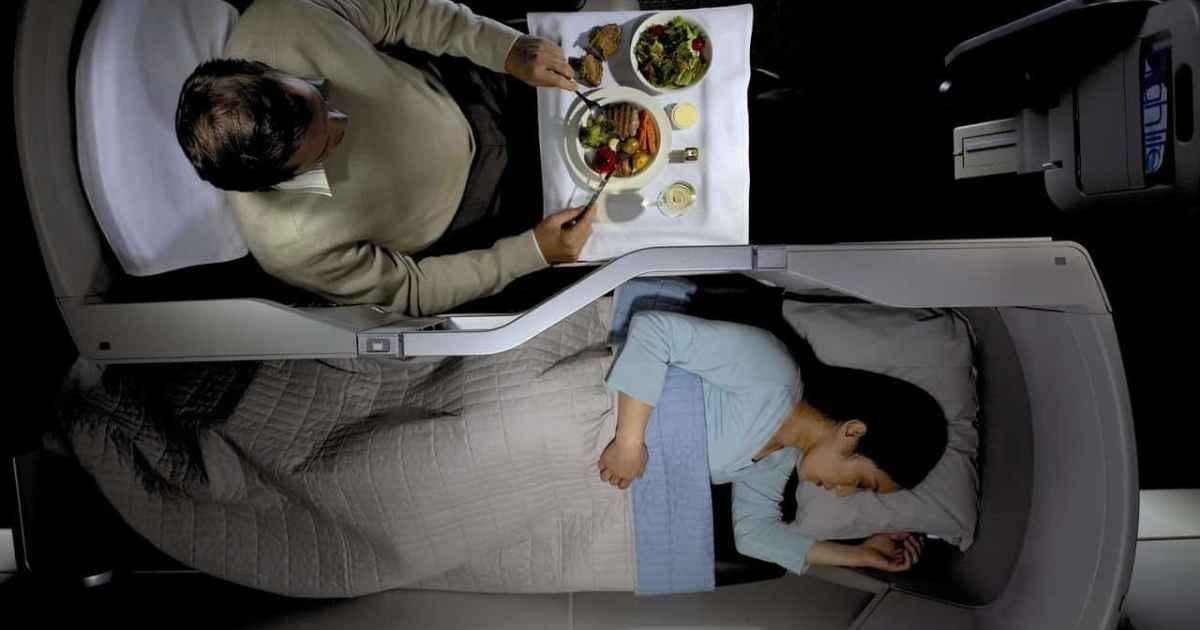
The single most important thing to check before booking: does the seat convert to a fully flat, 180-degree bed, not just "lie-flat." Many older business class configurations recline at an angle, which sounds fine until hour 12.
What the specs don't tell you: A 76-inch flat bed sounds generous until the footwell narrows to 18 inches. If you're over 6ft, always check seat maps on SeatGuru or the airline's own configurator, not just the brochure.
The airlines that consistently perform on this route
Not all business class products are equal, and on a 20-hour journey, the gap between a good and a mediocre seat becomes very obvious, very quickly.
Best Overall
Singapore Airlines
Business Suite on A380 via SIN. Direct aisle access from every seat. The quietest cabin in Australia, consistently.
Best Service
Qatar Airways
QSuite via DOH. Sliding-door privacy, double-bed option, best catering at 35,000 feet on any route.
Best Value
Emirates
Via DXB on A380 upper deck. Bar access, generous wine list, consistently upgradeable with points.
Direct Option
Qantas
Project Sunrise (nonstop LHR–SYD) launching in 2026. Current business class is solid but not best-in-class for hardware.
Lounge access: what you're actually entitled to and what's worth using
Business class on a major carrier gives you lounge access at both departure and connection airports. The question is which lounges, because the difference between a carrier's own flagship lounge and a Priority Pass affiliate is enormous.
At Dubai, Doha and Singapore, the airline's own lounges are genuinely world-class: à la carte dining, private shower suites, spa treatments, and nap rooms. At smaller hubs, always check whether you're being routed to the carrier's lounge or a contracted third-party it matters.
Insider note: Singapore Changi's SilverKris Business Lounge (T3) has a hawker-style food station that runs until midnight. It's not on the menu, ask the staff. Same with Emirates' Whisky Bar in DXB T3, which most passengers walk past without realising it exists.
Sleep strategy: how to actually arrive rested
Australia is typically 8–11 hours ahead of Europe and 14–18 hours ahead of the US East Coast. The jet lag direction, east to west on the way there, west to east returning, requires a completely different approach each way.
Outbound to Australia: stay awake through your first flight leg, eat a full meal, take your sleep aid (if you use one) at the start of the second leg and aim for at least 7 hours flat. Ask the cabin crew not to wake you for meals. A good crew will anticipate this without being asked.
What experienced long-haul travellers do differently: They request the mattress pad and pyjamas immediately after boarding, not after dinner. By the time most passengers are ready to sleep, the pyjama queue has formed, and the good mattress toppers are already out.
Food and drink: when to eat, when to skip, what to order
Business class menus to Australia are extensive, but eating everything on offer is one of the most reliable ways to feel terrible on arrival. The standard mistake is matching meals to the clock on the aircraft rather than eating to the destination time.
If you land in Sydney at 6 am, the last thing your body needs is a heavy pasta at what is actually 1 am local time. A light protein option, proper sleep, and breakfast just before landing works better than any meal the galley can produce at 35,000 feet.
On Qatar QSuite specifically: The mezze starter, the lamb ouzi and the date pudding are consistently outstanding. The wine list includes allocated Burgundy on some routes, ask what's in the cellar rather than ordering from the card.
What does a business class to Australia cost, and when to book
Return business-class fares from London typically range from $3,800 to $9,500, depending on the airline, season, and how far in advance you book. From the US East Coast, expect $4,200 to $8,500 return.
The sweet spot for points redemptions is Singapore Airlines KrisFlyer and Qatar Avios, both of which offer strong availability 7–10 months out, and premium cabin availability improves significantly at the 7-day mark when airlines release unsold seats.
Worth knowing: Australian school holidays (mid-January, mid-April, July, late September) push premium cabin fares up 25–40%. The most cost-efficient windows are late February through March, and late October through mid-November.
Connecting vs. direct: the real difference at this distance
There is currently no nonstop service from the US to Australia in any cabin, meaning a stop in Asia or the Gulf is unavoidable. From the UK, Qantas' Project Sunrise will offer nonstop London–Sydney by late 2026, but until then, a connection is part of the experience.
A well-chosen layover of 2 to 3 hours in Singapore or Doha is not a burden at this level of travel. You clear immigration in the transit zone, access a flagship lounge, shower, and re-board refreshed. A tight connection under 90 minutes in a large hub is the only scenario worth avoiding.
FAQ'S
Is business class worth it to Australia?
On any flight over 14 hours, a flat bed is not a luxury; it's a functional requirement. If you're arriving for business or have meetings within 48 hours of landing, business class is the only cabin that gives you a realistic chance of arriving ready to work.
Which airline has the best business class to Australia?
Singapore Airlines (A380 via SIN) and Qatar Airways (QSuite via DOH) lead on hardware and service. Emirates on the A380 upper deck is the best value and most upgradeable with points. Qantas is the only option for Australian carrier loyalty perks.
How do I avoid jet lag when flying to Australia in business class?
Eat to destination time, not aircraft time. Sleep on the second leg, not the first. Request pyjamas immediately after boarding. Avoid alcohol for the first four hours, as leg dehydration is worse at altitude than the time-zone shift itself.
What is the best seat in business class to Australia?
On the A380, the upper deck rows 11–14 (Singapore Airlines configuration) offer a smaller, quieter cabin. On QSuite, odd-numbered window seats give the best privacy. On Emirates, seats 7A and 7K on the upper deck have the widest footwells.
Can I use points to fly business class to Australia?
Yes, and it's one of the best value redemptions in premium travel. Singapore KrisFlyer, Qatar Avios, and Qantas Points all offer strong business class availability. Book 7–10 months out or check 7–10 days before departure when released seats appear.
1189
URL Copied
Previous Blog
Emirates Business Class Routes from the US: Full 2026 Guide
By providing my contact details and clicking on "REQUEST
QUOTE" I agree to be contacted for travel information via phone, text messages and
email. No purchase necessary. We respect your privacy
Thank You
for your request
We appreciate your interest. Your request is now being passed on to your dedicated travel consultant.
We will contact you shortly.






-66683232cd9be.jpg)