Please note that on our website, we use cookies. They are necessary for the functioning of our website and optimizing its performance. By clicking "Allow Cookies," you agree to our cookie policy. Learn
More
Available Now
(24/7, toll-free)
Looking for personalized itineraries or have questions about our services? We're here to
help.
Air Canada 787 Business Class Review: Complete Guide to Signature Class
April 27, 202627 min Read Last updated on April 27, 2026
Business Class
Flying Air Canada's 787 Dreamliner in business class means experiencing what the airline calls "Signature Class"their premium product for long-haul international routes. The 787 operates on key routes from US cities through Toronto, Montreal, and Vancouver to destinations across Europe, Asia, and beyond.
The product itself sits somewhere in the middle tier of international business class: better than most US carriers, not quite matching the Japanese or Middle Eastern carriers, but offering genuinae value when priced correctly. And that pricing element matters significantly, because published business class fares on Air Canada often run $4,500-6,500 roundtrip on transatlantic routes, while consolidator access regularly delivers the same seats at $2,800-3,800.
After reviewing the 787 business class experience across multiple routes and both aircraft variants (787-8 and 787-9), here's what you actually need to know before booking.
Quick Verdict: Is Air Canada 787 Business Class Worth It?
Book it when: You're connecting through Toronto, Montreal, or Vancouver to Europe or Asia, can confirm the 787 on your route, and access consolidator pricing below $3,500 roundtrip.
Skip it when: You're stuck with published fares above $5,000, when alternative carriers offer superior products at similar consolidator pricing, or if your route operates Air Canada's older 767 or A330 aircraft instead.
The product: Solid reverse herringbone seats with direct aisle access, inconsistent but generally good service, surprisingly strong dining for a North American carrier, and modern amenities. The 787 cabin feels freshthese are newer aircraft than Air Canada's aging 777s and A330s.
The Seat: Reverse Herringbone Configuration
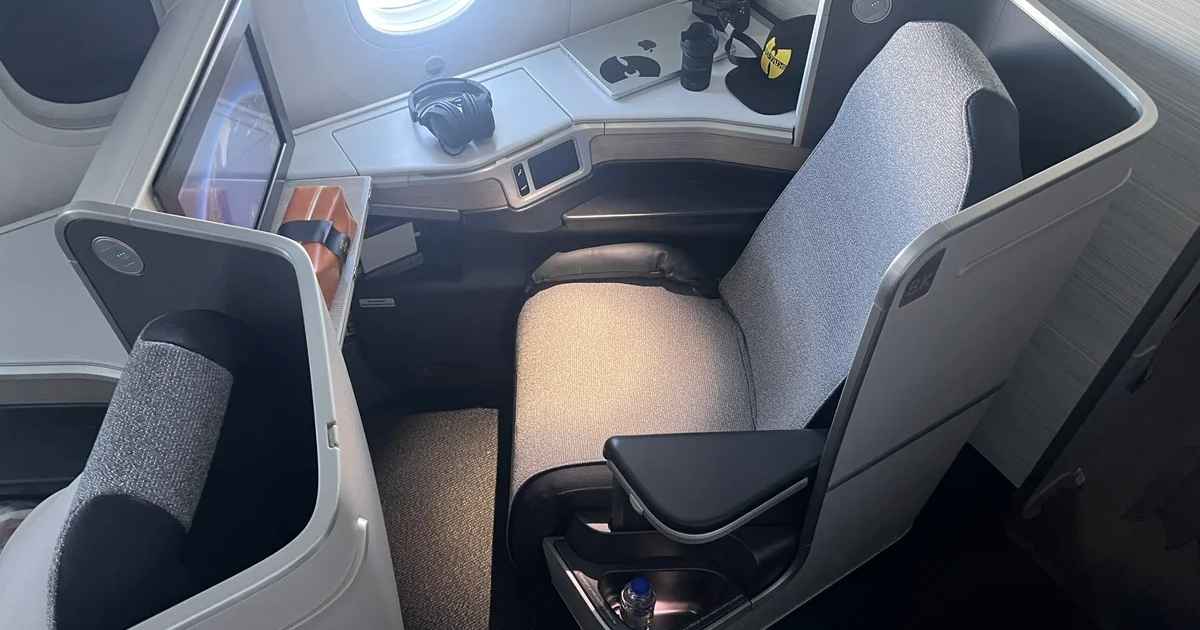
Air Canada's 787s feature what the industry calls reverse herringbone seatinga 1-2-1 layout where seats angle toward windows rather than straight ahead. Every passenger gets direct aisle access, and when fully reclined, the seats create individual cocoons angled away from the aisle.
787-9 Configuration (30 Seats)
The larger 787-9 variant features 30 business class seats spread across 8 rows. Seats 1D and 1G don't exist, creating a slightly odd first row with just window seats. The single cabin runs from Row 1 through Row 8.
Critical seat warning: Seats 5A and 5K have no windows. The fuselage curves inward at these positions, eliminating the window entirely. Avoid these seatsyou're paying for business class and staring at a blank wall for 7-10 hours.
Best seats on the 787-9:
8A and 8K: Back of cabin, nobody behind you, maximum privacy
2A and 2K: Front section with good privacy, first off the plane
5D and 5G: Center seats at back if traveling with companion (though divider doesn't lower)
Seats to avoid:
5A and 5K: No windows (dealbreaker for most)
Row 1: Proximity to galley and lavatory, early boarding noise
4D and 4G: Center seats with less privacy than row 5
787-8 Configuration (20 Seats)
The smaller 787-8 has just 20 business class seats across 5 rows in the same 1-2-1 reverse herringbone layout. More intimate cabin feel with half the passengers, but same seat limitations apply.
Best seats on the 787-8:
5D and 5G: Back of cabin, maximum privacy for center seats
3A and 3K: Mid-cabin windows with good all-around positioning
2A and 2K: Front cabin, quick exit
Seats to avoid:
5A and 5K: No windows (same problem as 787-9)
Row 1: Galley and lavatory proximity
Seat Dimensions and Comfort
The seats themselves measure approximately 21 inches wide and convert to a fully flat bed stretching 78-80 inches depending on measurement method. Air Canada markets them as "up to 80 inches" (203cm), which requires using every inch including the footwell.
The angle of recline in the reverse herringbone means your feet tuck into a compartment under the seat ahead. Taller passengers (6'2"+) fit comfortably, though you're sleeping at a diagonal angle rather than perfectly straight.
Storage breaks down as follows:
Large side console under the window (window seats only)
Shallow storage bin with power outlets and remote
Small personal item space near your feet
Overhead bins (standard 787 bins, larger than older aircraft)
The side console on window seats provides significant storagelarge enough for a laptop, tablet, book, and personal items. Center seats lack this feature, making them less practical for working passengers who need documents and devices accessible.
Seat controls sit on a panel at the side, operating intuitively for recline, lumbar support, and massage function. The massage setting feels more like gentle vibration than actual massagea nice touch but not transformative.
Privacy Considerations
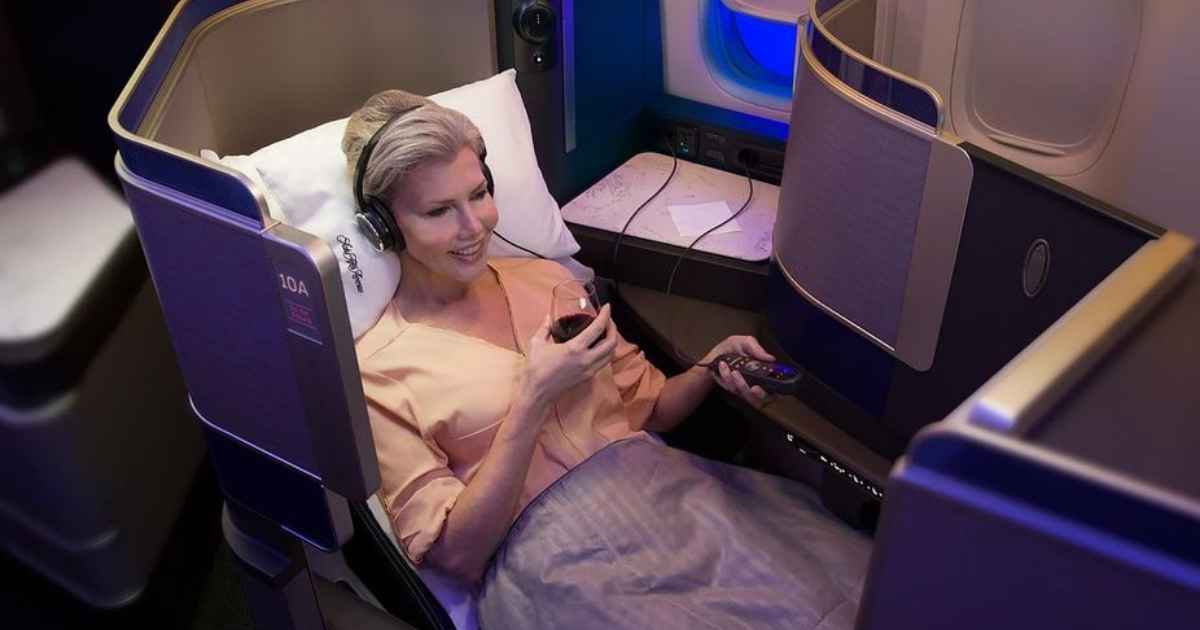
The reverse herringbone layout creates natural privacy through the angled seating. Window seat passengers face slightly toward the fuselage, while center seats angle gently away from each other. No closing doors or full privacy dividers existthis is an open cabin where people walking the aisle can see you.
For couples traveling together in center seats, the fixed divider between D and G seats doesn't lower. You can talk easily but can't hold hands or share space. Some passengers prefer sitting across the aisle from each other in window seats (one in A, one in K) for better sightlines.
The lack of doors means light sleepers may struggle with aisle traffic, galley activity, and lavatory queues visible from most seats. If you need absolute darkness and privacy to sleep, this product falls short of ANA's The Room or other doored suites.
Amenities and Technology
Each seat includes an 18-inch touchscreen entertainment systemlarger than Air Canada's older aircraft but smaller than the 24-inch screens on ANA or JAL. The system runs Air Canada's enRoute entertainment platform with a solid selection of recent films, TV shows, music, and games.
Content leans heavily Canadian (as expected) with strong coverage of Canadian films and series alongside mainstream Hollywood releases. The interface feels dated compared to newer systems from Asian carriers, but functions adequately. A handheld remote stores in the side compartment for passengers who prefer not to reach forward constantly.
Power and charging:
Universal power outlet (accepts most plug types)
USB-A port
No USB-C (a notable omission on newer aircraft)
No wireless charging
The absence of USB-C on aircraft delivered in recent years feels like an oversight. Most passengers now carry USB-C devices, requiring adapters or cables specifically for USB-A ports.
Wi-Fi operates across Air Canada's 787 fleet, though pricing runs high by industry standards. Free for Aeroplan elite members; pay-as-you-go for others. Connection quality variesgenerally adequate for email and messaging, less reliable for video calls or streaming.
Noise-canceling headphones come packaged at each seat. They're serviceable but not premium qualitypassengers with Bose or Sony headphones will prefer their own. The headphone jack accepts standard 3.5mm plugs.
Service and Flight Attendant Experience
Air Canada service quality varies dramatically based on crew base, route, and individual flight attendants. The airline's reputation sits somewhere between excellent and adequate depending on who you ask, and actual experience supports this range.
When service excels: Toronto-based crews on long-haul routes to Europe and Asia generally deliver warm, professional service that competes with top international carriers. Flight attendants are attentive without hovering, proactive about drink refills, and genuinely hospitable.
When service disappoints: Montreal-based crews receive consistent passenger complaints about indifference, lack of warmth, and minimal engagementparticularly toward non-French speaking passengers. This isn't universal but occurs frequently enough to warrant mention.
The reality is that Air Canada operates with unionized crew members who have varying levels of engagement. Excellent flight attendants deliver service that rivals Singapore Airlines or ANA. Disengaged crew members do the minimum required and disappear between services.
Pre-departure beverage service happens inconsistently. Some flights offer orange juice or water during boarding; others skip this entirely. The purser sometimes walks through the cabin greeting passengers individuallya nice touch when it happens.
Dining: Surprisingly Strong for North American Carrier
Air Canada's business class dining surpasses most US carriers significantly. The airline works with chef David Hawksworth to develop menus, and the execution shows notably better quality than United Polaris or Delta One.
Meal Service Structure
On transatlantic flights (6-8 hours), expect:
Pre-departure beverage (inconsistent)
Appetizer service shortly after takeoff
Main course with bread service
Cheese and dessert
Pre-arrival snack or meal (depending on time)
On transpacific flights (10+ hours), full dinner service followed by light breakfast or brunch before arrival. The airline also offers "mid-flight refreshments"basically a snack basket you can request anytime.
Food Quality
The appetizers typically showcase Canadian ingredientssmoked salmon, local cheeses, seasonal vegetables prepared competently. Main courses vary but often include beef, chicken, fish, and vegetarian options. The beef tends to be the strongest choice; chicken can be dry.
Presentation looks refinedproper china, well-plated dishes, attention to visual appeal. The food doesn't match the artistry of Asian carriers like JAL or Thai Airways, but it surpasses the mediocre plating common on US airlines.
One recurring complaint: bread service. The bread arrives warm but tastes generic. For an airline emphasizing Canadian ingredients and chef collaboration, the bread feels like an afterthought.
Cheese course features Canadian cheeses with accompaniments. This element genuinely impressesthe cheese selection often includes interesting varieties from Quebec and Ontario producers, properly ripened and presented.
Dessert varies from excellent to forgettable. When Air Canada features seasonal Canadian desserts (maple-based options, berry tarts), they're memorable. Standard chocolate mousse or tiramisu feels uninspired.
Beverage Program
Wine selection skews toward Canadian, French, and Californian bottles. The sommelier-selected wines are competentnot exceptional, but better than average for business class. Sparkling wine on most routes is Jaillance Crémant de Bordeaux Brut, a drinkable if unremarkable choice.
Premium champagne (Moët & Chandon) appears in the Signature Suite lounges at Toronto and Vancouver but rarely makes it onto the aircraft itself.
Spirits include standard well brands plus some Canadian whisky options. Beer selection emphasizes Canadian craft breweriesa nice touch. Non-alcoholic options cover the basics: juices, soft drinks, coffee, tea.
Coffee quality disappoints. For an airline emphasizing premium service, the coffee tastes generic and weak. If you care about your morning coffee, eat breakfast in the lounge instead.
Special Meals
Pre-ordered special meals (vegetarian, vegan, gluten-free, religious dietary needs) receive mixed reviews. The vegetarian meals sometimes surpass the standard menu; other times they're afterthoughts. If you have dietary restrictions, set expectations accordingly and consider eating substantively in the lounge.
Lounges: Signature Suite vs Maple Leaf Lounges
Business class passengers access Air Canada lounges at most airports, though quality varies dramatically by location.
Air Canada Signature Suite (Toronto and Vancouver)
These flagship lounges at Toronto Pearson (YYZ) and Vancouver International (YVR) deliver genuinely excellent experiences. Located in Terminal 1 at both airports, they feature:
À la carte dining by chef David Hawksworth
Full bar with Moët & Chandon champagne
Personalized concierge service
Molton Brown spa products
Shower facilities
Quiet zones and workspaces
The à la carte dining elevates these lounges above standard airline clubs. Order from a menu rather than buffet service, with dishes prepared on-demand. Quality matches mid-tier restaurantsfar superior to typical lounge food.
Access requires flying Air Canada Signature Class (business) on international routes to Europe, Asia, South America, Australia, or New Zealand. Domestic business class doesn't qualify.
Maple Leaf Lounges (Standard)
Air Canada operates 23 Maple Leaf Lounges across Canada, US, and Europe. These range from excellent (Montreal international lounge) to adequate (smaller regional locations).
Standard features:
Buffet food service (quality varies)
Beer, wine, spirits
Soft drinks and coffee
Wi-Fi and workspaces
Some locations have showers
The Toronto domestic lounge and Air Canada Café feel overcrowded during peak hours. Food selection leans toward mass-appeal items rather than interesting choices. Still better than United Clubs, roughly equivalent to Delta Sky Clubs.
European Maple Leaf Lounges (London Heathrow, Paris CDG, Frankfurt) receive better reviews than North American locations, often featuring better food and less crowding.
Lounge Access Rules
Air Canada Signature Class (business): Access to Maple Leaf Lounges when departing or arriving on Air Canada
Connecting flights: Access when connecting between Air Canada flights in business class
Aeroplan elite members: Access regardless of cabin
Star Alliance Gold: Access to Star Alliance lounges when not a Maple Leaf Lounge
If connecting through airports without Maple Leaf Lounges, business class passengers access contract Star Alliance partner lounges by showing boarding passes.
Routes and Aircraft Deployment
Air Canada operates 787s on long-haul international routes from its three major hubs: Toronto (YYZ), Montreal (YUL), and Vancouver (YVR). Understanding which routes use 787s matters because aircraft swaps happen, and ending up on an older 767 or A330 significantly degrades the experience.
From Toronto (YYZ)
Toronto operates the most extensive 787 network, with regular service to:
Note: Toronto also operates 787s to some US destinations seasonally (Las Vegas, Phoenix, Los Angeles) during winter months when demand justifies widebody aircraft. These represent opportunities for US travelers to experience business class on 2-5 hour flights at reasonable prices.
From Montreal (YUL)
Montreal's 787 network focuses on transatlantic routes:
Europe:
London Heathrow (daily 787)
Paris CDG (787)
Brussels, Geneva (787 service)
Caribbean/Central America:
Fort Lauderdale (seasonal 787)
Other sun destinations during peak season
From Vancouver (YVR)
Vancouver operates 787s primarily on transpacific routes:
Asia:
Tokyo Narita (787)
Seoul Incheon (787)
Hong Kong (787)
Singapore (787)
Bangkok (seasonal 787)
Delhi (787)
Australia/New Zealand:
Sydney, Melbourne (787)
Auckland (787)
Middle East:
Dubai (seasonal 787)
From US Cities
Direct 787 service from US cities remains limited. Most US-origin passengers connect through Toronto, Montreal, or Vancouver. However, Air Canada operates some transborder 787 flights:
Newark (EWR) to Vancouver (787-9, daily)
Los Angeles to Toronto (787, select flights)
San Francisco to Vancouver (occasionally 787)
The majority of US passengers booking Air Canada business class connect through Canadian hubs on narrowbody aircraft (A220, A320, 737) before joining 787 flights to final destinations.
Aircraft Reliability and Substitutions
Air Canada maintains good 787 operational reliability, but equipment swaps happen. Routes scheduled for 787 service sometimes operate with older 777-300ER, 767, or A330 aircraft due to maintenance or scheduling needs.
The 777-300ER business class roughly matches the 787 (similar reverse herringbone seats, slightly older). The 767 and older A330s feature outdated business class that significantly disappointsavoid these aircraft if possible.
How to verify aircraft before flying:
Check booking confirmation for aircraft type (789 = 787-9, 788 = 787-8)
Use SeatGuru or ExpertFlyer to confirm seat map matches 787 configuration
Monitor ExpertFlyer or FlightRadar24 closer to departure for equipment changes
If Air Canada swaps your 787 to inferior aircraft after booking, contact them immediately. They sometimes accommodate rebooking to different flights with better equipment, especially for advance bookings.
Pricing Reality: Published Fares vs Consolidator Access
This is where Air Canada business class becomes genuinely interesting from a value perspective.
Published business class fares (what you see on aircanada.com or Google Flights):
Transatlantic (Toronto/Montreal to Europe):
Peak season (summer, holidays): $5,500 - $7,200 roundtrip
Shoulder season (spring, fall): $4,200 - $5,800 roundtrip
Off-peak (winter): $3,800 - $5,200 roundtrip
Transpacific (Vancouver to Asia):
Peak season: $6,200 - $8,500 roundtrip
Shoulder season: $4,800 - $6,800 roundtrip
Off-peak: $4,200 - $6,200 roundtrip
These published fares fluctuate wildly based on demand, advance booking window, and Air Canada's dynamic pricing algorithms. The same route might price at $4,500 one week and $7,200 the next.
Consolidator pricing (unpublished fares through trade channels):
The same routes accessed through consolidator agreements regularly price:
Transatlantic:
Peak season: $3,200 - $4,200 roundtrip
Shoulder season: $2,800 - $3,600 roundtrip
Off-peak: $2,400 - $3,200 roundtrip
Transpacific:
Peak season: $3,800 - $5,200 roundtrip
Shoulder season: $3,200 - $4,400 roundtrip
Off-peak: $2,800 - $4,000 roundtrip
Recent client example: Toronto to London on 787 Dreamliner in September. Published fare: $5,680 roundtrip. Consolidator fare secured: $3,240 roundtrip. Identical flight, same seat, same service$2,440 saved.
These consolidator fares come from bulk contracts between travel agencies and airlines, unpublished inventory allocations, and negotiated rates that don't appear in consumer booking systems. Air Canada actively maintains these distribution channels because filled business class seats at consolidator pricing beat empty seats.
The practical challenge: consolidator inventory isn't searchable on Google Flights, Kayak, or aircanada.com. Access requires working with agencies that hold these contracts and maintain relationships with multiple consolidators.
Frequent Flyer Programs and Award Booking
Air Canada operates the Aeroplan loyalty program, which uses dynamic pricing for award seats. This means award prices fluctuate based on demand, sometimes reaching absurd levels.
Aeroplan award pricing for 787 business class:
Domestic Canada: 25,000 - 60,000 points one-way
US to Canada: 20,000 - 70,000 points one-way
North America to Europe: 55,000 - 150,000+ points one-way
North America to Asia: 75,000 - 200,000+ points one-way
The massive range reflects dynamic pricing. Sometimes you find excellent value (60,000 points to Europe); other times the system demands 140,000 points for the same route on different dates.
Aeroplan elite status and credit cards provide "preferred pricing" lower point requirements for the same flights. The difference can be substantial: 82,600 points for regular members versus 64,900 points for elite/cardholders on the same Toronto-Vancouver business class flight.
Partner program options:
United MileagePlus: 88,000 miles one-way to Europe or Asia (fixed pricing, no fuel surcharges on transborder routes)
Avianca LifeMiles: 63,000 miles one-way to Europe, 87,500 to Asia (watch for LifeMiles transfer bonuses)
Turkish Miles&Smiles: Excellent fixed pricing, minimal fuel surcharges, but harder to accumulate
For most US travelers, transferring Chase Ultimate Rewards or American Express Membership Rewards to Aeroplan delivers the best flexibility. Monitor pricing across different datesdynamic pricing means flexibility saves thousands of points.
The Consolidator Pricing Advantage Explained
One more note on how consolidator pricing actually works, since this dramatically impacts whether Air Canada 787 business class represents good value.
Airlines price routes dynamically based on demand, competition, and internal yield management. The $5,800 published fare exists because some passengers will pay it. But Air Canada also knows business class cabins often have empty seats, especially mid-week shoulder season flights.
Rather than sell those seats at lower published prices (which undermines the $5,800 fare structure), airlines distribute inventory through parallel channels:
Bulk contracts with consolidators: Travel agencies with high volume purchase blocks of business class inventory at contracted rates
Unpublished fare codes: Special booking codes not visible in consumer systems
Corporate contracts: Negotiated rates for business travel that spill into trade channels
Opaque inventory: Last-minute availability sold through trade-only platforms
These channels exist globally, maintained by a network of consolidators in different markets. A US-based agency with strong Canada-Europe consolidator relationships can access inventory a consumer searching aircanada.com never sees.
The practical result: published fares represent the airline's "aspirational" pricing. Consolidator fares reflect what the airline actually accepts to fill seats.
For Air Canada specifically, consolidator availability tends strongest on:
Routes with multiple daily frequencies (Toronto-London, Vancouver-Hong Kong)
Return dates with 7+ night stays
The tightest consolidator inventory appears during:
Summer peak (June-August)
Holiday periods (Christmas, New Year)
Canadian long weekends
Special events (Olympics, major conferences)
Even during peak periods, consolidator fares typically beat published pricing by 25-35%. During shoulder and off-peak, savings reach 45-55%.
Comparing Air Canada 787 to Competitors
Understanding where Air Canada's 787 business class sits versus alternatives helps determine when it makes sense.
Superior to:
United Polaris 787 (newer but less refined service and dining)
Delta One A330/767 (older aircraft, inferior seats)
American 777-200 (outdated configuration)
Any US carrier's transatlantic business class
Roughly equivalent to:
Lufthansa Business Class 747/A340 (older but consistent service)
Swiss Business Class A330/A340 (similar quality overall)
Austrian Business Class 777/787 (comparable product)
Inferior to:
ANA The Room 777 (privacy, seat size, service)
JAL Sky Suite (dining quality, service consistency)
Singapore Airlines Business Class (seat length, service)
Lufthansa Business Class 747-8/A350 (newer seats, better amenities)
Turkish Airlines Business Class 777/787 (dining, lounge access)
The honest assessment: Air Canada's 787 business class delivers solid mid-tier international business class that earns its place when priced appropriately. At $3,000-3,500 roundtrip consolidator pricing, it represents excellent value. At $6,000+ published fares, alternatives often deliver better experiences for similar money.
Pros and Cons Summary
What Works:
✅ Reverse herringbone seats with direct aisle access ✅ Fully lie-flat beds adequate for most passengers ✅ Dining quality surpasses US carriers significantly ✅ Modern 787 cabin with larger windows, better air pressure ✅ Extensive route network from Toronto, Montreal, Vancouver ✅ Strong consolidator pricing delivers 40-50% savings ✅ Signature Suite lounges in Toronto/Vancouver genuinely excellent ✅ Consistent hard product (same seats across 787 fleet)
What Doesn't:
❌ Service quality highly variable (crew base dependent) ❌ No closing doors or full privacy ❌ Seats 5A/5K missing windows on both aircraft variants ❌ Entertainment screens smaller than Asian competitors ❌ No USB-C charging (requires adapters) ❌ Coffee quality disappointing for premium cabin ❌ Published fares often overpriced relative to product ❌ Award pricing using Aeroplan wildly inconsistent
Who Should Book Air Canada 787 Business Class
Ideal passengers:
US travelers connecting through Toronto, Montreal, or Vancouver to Europe or Asia
Passengers who secured consolidator pricing under $3,500 roundtrip
Aeroplan members with points to burn and found reasonable award pricing
Business travelers prioritizing flat beds and direct aisle access
Anyone avoiding US carriers' inferior business class products
Consider alternatives if:
You're stuck paying $5,500+ published fares (shop competitors)
Service consistency matters more than product (Asian carriers)
You need absolute privacy to sleep (ANA, new Lufthansa, some ME carriers)
Your route operates Air Canada's 767 or older A330 instead of 787
You're connecting from US on long positioning flights (adds trip time)
Final Recommendation
Air Canada's 787 Dreamliner business class occupies the "very good when priced right" category. The hard product competes well with European carriers and surpasses all US competitors. Service ranges from excellent to adequate depending on crew. Dining quality surprises positively for a North American airline.
The determining factor: pricing. At consolidator rates of $2,800-4,200 roundtrip, this product delivers strong value. You're getting a genuine lie-flat seat, decent service, good food, and modern aircraft for 40-50% less than published fares.
At published rates of $5,000-7,000, the value proposition weakens considerably. For those prices, competitors like Lufthansa, Turkish, or even positioning to fly ANA or JAL might deliver better experiences.
For US travelers specifically, Air Canada works well when:
You're already transiting through Canadian hubs for geographic convenience
Consolidator pricing brings costs down to competitive levels
Schedule timing favors Air Canada over alternatives
You're based in cities with strong Air Canada connectivity
The 787 represents Air Canada's most modern long-haul aircraft. Until the airline introduces new business class products (787-10 deliveries starting 2026-2027 may bring updates), this is what you get. It's goodnot exceptional, not disappointing, but genuinely competitive when priced appropriately.
If you can access consolidator fares and confirm 787 equipment, booking Air Canada business class makes sense. If you're stuck with published pricing or aircraft substitution risks, shop alternatives before committing.
Frequently Asked Questions
Is Air Canada 787 business class lie-flat?
Yes, all Air Canada 787 business class seats fully recline to lie-flat beds measuring 78-80 inches long. The reverse herringbone configuration means you sleep at a diagonal angle with feet in a compartment under the seat ahead, but the bed is genuinely flat.
Which Air Canada 787 seats should I avoid?
Avoid seats 5A and 5K on both 787-8 and 787-9 aircraftthese positions have no windows due to fuselage curvature. Also avoid Row 1 for galley and lavatory proximity. Best seats: 8A/8K (787-9) or 5D/5G for back-of-cabin privacy.
How much does Air Canada business class cost to Europe?
Published fares range from $3,800-$7,200 roundtrip depending on season and route. Through consolidator channels, the same flights price $2,400-$4,200 roundtriptypically 40-50% savings. Peak summer travel commands highest prices; shoulder season (May, September) offers best value.
Does Air Canada 787 have Wi-Fi?
Yes, all Air Canada 787s feature Wi-Fi. However, it's not free except for Aeroplan elite members. Pay-as-you-go options available for other passengers. Connection quality adequate for email and messaging, less reliable for video calls.
What's the difference between 787-8 and 787-9 business class?
Both feature identical reverse herringbone seats and service. The 787-9 has 30 business class seats across 8 rows; the 787-8 has 20 seats across 5 rows. The smaller cabin on the 787-8 feels more intimate with fewer passengers, but the seat product is the same.
Can I use miles to book Air Canada 787 business class?
Yes, through Aeroplan (55,000-150,000+ points one-way to Europe/Asia with dynamic pricing), United MileagePlus (88,000 miles fixed pricing), Avianca LifeMiles (63,000-87,500 miles), or Turkish Miles&Smiles. Aeroplan pricing varies wildly; partner programs offer more predictable rates.
Does Air Canada business class include lounge access?
Yes, business class passengers access Air Canada Maple Leaf Lounges worldwide. Signature Class passengers to Europe, Asia, South America, Australia, or New Zealand departing from Toronto or Vancouver also access the premium Signature Suite with à la carte dining.
What routes does Air Canada fly the 787?
Main 787 routes: Toronto to London/Paris/Frankfurt/Tokyo/Delhi/São Paulo, Montreal to London/Paris, Vancouver to Tokyo/Hong Kong/Seoul/Singapore/Sydney/Dubai. Some seasonal US routes (Toronto to Las Vegas/Phoenix, Newark to Vancouver) also use 787s.
How does Air Canada 787 business class compare to United Polaris?
Air Canada's 787 business class offers better dining, similar seat comfort, and more consistent service quality than United Polaris. Both feature reverse herringbone 1-2-1 configurations. Air Canada edges ahead on food quality and overall experience, especially when consolidator pricing makes it more affordable.
What amenities come with Air Canada 787 business class?
Amenities include noise-canceling headphones, amenity kit (socks, eye mask, toiletries), pillow and duvet, mattress pad, 18-inch entertainment screen, power outlet, USB-A port (no USB-C), priority check-in, priority boarding, two checked bags, and lounge access.
Is Air Canada business class worth the upgrade from economy?
When using consolidator pricing ($2,800-4,200 vs $800-1,200 economy), yesthe $2,000-3,000 premium buys genuine comfort, sleep quality, and arrival refreshed. At published fares ($5,500+ vs $1,000 economy), the $4,500+ premium becomes harder to justify unless business pays or you use points.
Note: Air Canada regularly updates routes, schedules, and aircraft assignments. Before booking, verify current 787 deployment on your specific route and dates. Aircraft substitutions can occur due to operational needs.
6823
URL Copied
Previous Blog
British Airways Club Suites vs Club World: What's the Difference?
Next Blog
The Ultimate Guide to Business Class Flights: US West Coast to Europe in 2026
By providing my contact details and clicking on "REQUEST
QUOTE" I agree to be contacted for travel information via phone, text messages and
email. No purchase necessary. We respect your privacy
Thank You
for your request
We appreciate your interest. Your request is now being passed on to your dedicated travel consultant.
We will contact you shortly.