Please note that on our website, we use cookies. They are necessary for the functioning of our website and optimizing its performance. By clicking "Allow Cookies," you agree to our cookie policy. Learn
More
Available Now
(24/7, toll-free)
Looking for personalized itineraries or have questions about our services? We're here to
help.
Complete Guide to Airline fare codes: What those letters on your ticket mean
January 8, 202631 min Read Last updated on January 8, 2026
Airlines
Expert analysis by BusinessTravel365 | Last updated: January 2026
When you book a flight, you're not just buying a seat. You're buying a specific fare code that determines everything from your refund rights to upgrade eligibility to how many miles you'll earn. Yet most travelers have no idea what those mysterious letters on their tickets mean.
Here's the truth: Understanding airline fare codes can save you thousands of dollars and unlock benefits you didn't know existed. After booking tens of thousands of business and first-class tickets through consolidator channels, I've learned that the difference between fare code J and fare code D on the same business class seat can mean $3,000 in savings, different cancellation policies, and vastly different mileage-earning rates.
This comprehensive guide explains everything you need to know about airline fare codes, how they affect your travel, and how to use this knowledge to get better value from every booking.
Quick answer: What are airline fare codes?
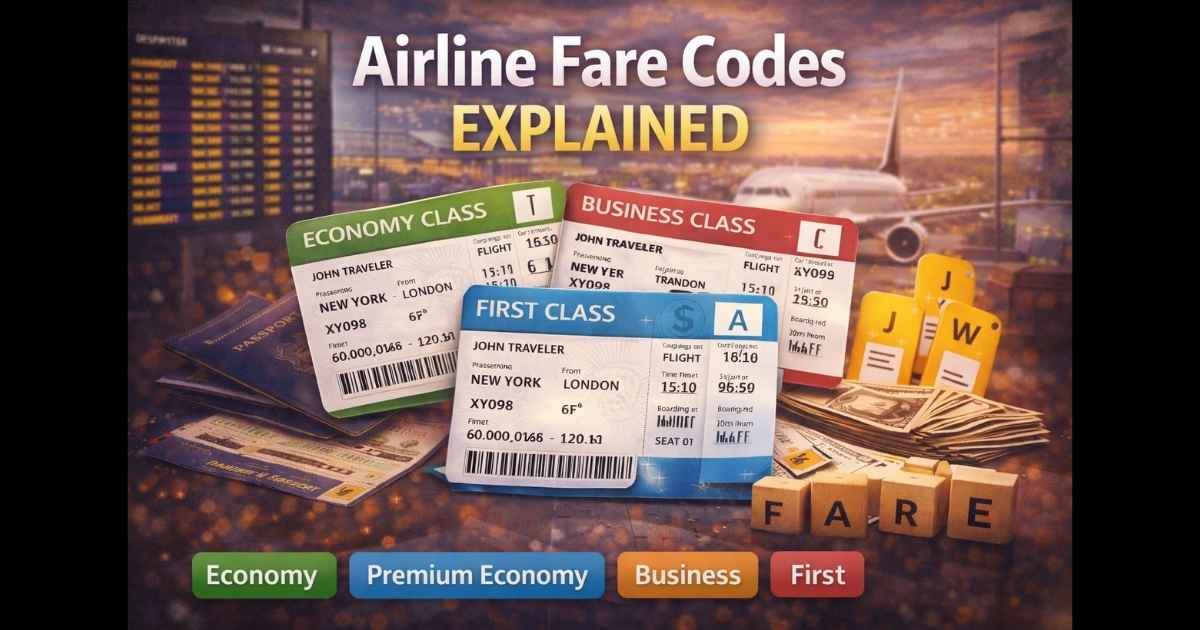
Airline fare codes (also called booking classes or fare classes) are short words that airlines use to group tickets based on price, limits, benefits, and availability. The same physical seat in business class might be sold under 8 different fare codes, each with different prices and rules.
Common fare code categories:
First Class: F, A, P
Business Class: J, C, D, I, Z
Premium Economy: W, E, R
Economy: Y, B, M, H, Q, K, L, T, V, S, N
The fare code determines:
How much you pay (higher letters = more expensive, more flexible)
Refund and change policies
Upgrade eligibility
Frequent-flyer mile-earning rates
Seat selection priority
Standby eligibility
Critical insight: Two passengers sitting next to each other in business class might have paid vastly different amounts, one booked fare code J (full-fare business), the other booked fare code D (discounted business). Same seat, same service, different price, different benefits.
At BusinessTravel365, we get fare codes that are often not available to the public. We offer business class for 45-60% less than the regular fare, while still earning good money and being flexible.
Understanding the fare code hierarchy
Airlines organize fare codes in a specific hierarchy that determines both price and flexibility. Think of it as a pyramid,the higher you go, the more expensive but more flexible the ticket becomes.
The basic hierarchy (most airlines)
Premium cabins follow this pattern:
First Class:
F - Full-fare first class (100% flexible, full refund, highest earning)
A - Discounted first class (some restrictions, good earning)
P - Deeply discounted first class (more restrictions, reduced earning)
Business Class:
J - Full-fare business class (100% flexible, full refund, 150% earning typical)
C - Premium business class (flexible, good refund terms, 125-150% earning)
D - Standard business class (moderate flexibility, 100-125% earning)
I - Discounted business class (some restrictions, 100% earning)
Z - Deep discount business class (restrictive, 75-100% earning)
Premium Economy:
W - Full-fare premium economy (flexible, good earning)
E - Standard premium economy (moderate flexibility)
R - Discounted premium economy (restrictive)
Economy Class:
Y - Full-fare economy (100% flexible, full refund, 100% earning)
B - High economy (good flexibility, 100% earning)
M - Mid-tier economy (some flexibility, 100% earning)
H - Discounted economy (moderate restrictions, 50-100% earning)
Important: The exact hierarchy varies by airline. United might use different letters than American, which differs from international carriers. But the principle remains: earlier alphabet letters = more expensive and flexible. Later letters = cheaper and more restrictive.
Why this matters for your booking
When you search for flights on airline websites or Online Travel Agencies (OTAs), you're seeing different fare codes without realizing it. That "$450 economy ticket" might be fare code Q, while the "$850 economy ticket" is fare code Y, same physical seat, completely different benefits.
Understanding fare codes helps you:
Compare true value, not just price
Predict what changes or cancellations will cost
Estimate frequent flyer earnings before booking
Know upgrade possibilities before purchasing
Understand why the "same seat" costs differently
Consolidator advantage: When you book through consolidator channels like BusinessTravel365, you get better deals than public fares. You can get cheaper prices and better benefits than public fares. A consolidated J-class ticket might cost 50% less than the published J fare while maintaining the same J-class benefits.
Your fare code appears in multiple places, though airlines don't always make it obvious. Here's where to look:
On your ticket
E-ticket confirmation:
Look for a section labeled "Fare Basis" or "Booking Class." You'll see something like:
The first letter is your actual fare code. Everything after that is fare basis information (date restrictions, minimum stay requirements, routing codes, etc.).
Example: If your fare basis shows "D7PRBUS," your fare code is D (discounted business class).
On airline websites
When you log into your reservation on the airline's website:
United Airlines: Under "Ticket Details" → Look for "Fare Class"
American Airlines: Under "Trip Details" → "Fare Information"
Delta: Under "My Trips" → "Flight Details" → Look for single letter near price
International carriers: Usually under "Booking Details" or "Fare Information"
Using third-party tools
ExpertFlyer.com: Enter your confirmation code to see detailed fare class information, including:
Current fare code
Upgrade eligibility based on fare code
Mileage-earning rates
Change/cancellation rules
Airline apps: Most airline mobile apps show fare codes in the booking details section.
When booking
At booking time, you usually see multiple fare options, even if they're not labeled clearly:
"Basic Economy" = Usually V, N, or S fare codes
"Main Cabin" = Usually Q, K, or H fare codes
"Flexible Economy" = Usually M, B, or Y fare codes
"Business Class" = Could be any of J, C, D, I, Z depending on price point
The cheaper the option, the further down the alphabet the fare code typically sits.
Fare codes by airline (detailed breakdown)
Different airlines use fare codes differently. Here's what matters for major carriers:
Y - Full-fare economy (rare, expensive, 100% PQD earning)
B - Flexible economy (100% PQD earning)
M, H - Mid-tier economy (100% PQD earning)
Q, K, L, T - Discounted economy (50% PQD earning)
N - Basic Economy (No overhead bin on some routes, last boarding)
Consolidator insight: Our United Polaris consolidator fares usually book as D or Z class. They offer the full Polaris experience at 40%-50% less than J-class prices while still earning 100% of the mileage earned.
American Airlines fare codes
Flagship Business (International):
J - Full-fare business ($9,000-14,000 transatlantic)
C - Premium business ($7,000-10,000)
D - Standard business ($6,000-8,500)
I - Discounted business ($5,000-7,000)
R - Deep discount business (restricted)
Domestic First:
F - Full-fare first
A - Discounted first
J - Premium First (transcontinental)
Economy:
Y - Full-fare economy
B, H, M, S - Mid-tier economy with different restrictions
Q, K, L, V, G - Discounted economy
N - Basic Economy
American's quirk: On transcontinental routes (JFK-lax, etc.), domestic first uses J class (same as business), but benefits differ from international J class.
Delta Air Lines fare codes
Delta One (long-haul business):
J - Full-fare Delta One ($9,500-15,000 transatlantic)
C - Premium Delta One ($7,500-11,000)
D - Standard Delta One ($6,500-9,000)
I - Discounted Delta One ($5,500-7,500)
Z - Deep discount Delta One (highly restricted)
Domestic First:
F - Full-fare domestic first
J - Premium Transcontinental (A330)
P, A - Discounted domestic first
Premium Select (Premium Economy):
W - Premium Select full fare
P, A - Discounted Premium Select
Economy:
Y - Full-fare Main Cabin
B, M, H, Q - Mid-tier Main Cabin
K, L - Discounted Main Cabin
E - Basic Economy
Delta's quirk: Delta has eliminated published award charts, making fare code impacts on earning less predictable than United or American.
International carriers (selected examples)
Lufthansa:
C - Business Class full fare
D - Business Class discounted
Z, P - Business Class deep discount
Y - Economy full-fare
B, M, U, H, Q, V, W - Economy discounted tiers
British Airways:
F - First Class full
A - First Class discounted
J - Club World (Business) full
C - Club World Discount
D, I - Club World deeper discounts
Y - World Traveller (Economy) full
B, H, K, M, L - Discounted economy tiers
Singapore Airlines:
F - Suites full-fare
P, A - suites discounted
J - Business full-fare
C, D, Z - Business discounted
Y - Economy full
B, E, M, H, K - Economy discounted
Emirates:
F - First Class full
A, P - First Class discounted
J - Business full-fare
C - Business discounted
D, I, Z - Business deep discount
Y - Economy full
B, M, H, K - Economy tiers
Key takeaway: Most international carriers follow similar patterns, J/C/D for business, Y/B/M for economy, but the exact restrictions and earning rates vary.
Fare codes and frequent flyer programs
Your fare code dramatically impacts frequent flyer miles and status earning. This is where understanding fare codes becomes financially significant.
Mileage earning by fare code
General patterns (most programs):
Premium cabin fare codes:
F, A (First) - Typically 300-400% of distance flown
J, C (Business full/premium) - Typically 150-200% of distance
D, I (Business discounted) - Typically 100-150% of distance
Z, P (Business deep discount) - Typically 75-125% of distance
W, E (Premium economy) - Typically 100-150% of distance
Economy fare codes:
Y, B, M (Full/flexible economy) - 100% of distance
H, Q, K (Discounted economy) - 50-100% of distance
L, T, V (Deep discount economy) - 25-75% of distance
N, S (Basic economy) - 0-50% of distance
United MileagePlus example:
New York (EWR) to London (LHR) = 3,459 miles
J class: 3,459 x 150% = 5,189 award miles
D class: 3,459 x 125% = 4,324 award miles
Z class: 3,459 x 100% = 3,459 award miles
Y economy: 3,459 x 100% = 3,459 award miles
Q economy: 3,459 x 50% = 1,730 award miles
N basic economy: 3,459 x 0% = 0 award miles
Status impact: For Premier Qualifying Dollars (PQD), fare codes matter even more:
Z class $4,500 ticket: 6,300 PQD (ticket price + 40% bonus)
Same flight, same seat, but J earns 5,633 more PQD toward status
Strategic fare code selection
When chasing elite status:
If your goal is hitting elite status requirements (PQD, PQMs, or PQFs on United; EQDs and EQMs on American; MQDs and MQMs on Delta):
Choose higher fare codes, even if they cost more:
J or C class for business instead of I or Z
Y or B for economy instead of Q or K
The extra cost might be justified by status benefits
Example calculation:
United's 1K status requires 18,000 Premier qualifying points (PQP) and $15,000 PQD.
Option 1: Book 10 flights in Z-class business averaging $4,500 each
Cost: $45,000
PQD: ~63,000 (far exceeds requirement)
PQP: Would depend on distance but likely sufficient
Option 2: Book 6 flights in J-class business averaging $8,500 each
Cost: $51,000
PQD: ~71,400 (exceeds requirement)
PQP: Higher earning rate gets you there on fewer flights
Option 3 (Consolidator): Book 10 flights through BusinessTravel365 in D-class at $4,000 each
Cost: $40,000 (saves $5,000+ vs Option 1)
PQD: ~56,000 (exceeds requirement)
PQP: Good earning rate reaches threshold
The consolidator's advantage: We can often book higher fare codes (J, C, D) at prices that are similar to or lower than published deep discount codes (Z, I). This will maximize your earnings while reducing costs.
When flying partner airlines (e.g., United tickets on Lufthansa, or American tickets on British Airways), fare codes determine earning rates in your home program.
Example: United MileagePlus earning on Lufthansa
Frankfurt to New York on Lufthansa (4,050 miles):
C class (LH Business): 6,075 miles (150% earning)
D class (LH Business): 4,050 miles (100% earning)
Z class (LH Business): 3,038 miles (75% earning)
Same business class seat, 3,037-mile difference in earning between highest and lowest fare codes.
Pro tip: Check your frequent flyer program's partner earning chart before booking. Sometimes booking directly through the operating carrier gets you a better fare code than booking through your home carrier.
How fare codes affect ticket flexibility
Beyond earning, fare codes, determine what happens when your plans change.
Changes and cancellations by fare code
General patterns (verify with specific airline):
Premium fare codes (J, C, F, A in their class):
Changes: Usually free or small fee ($0-200)
Cancellations: Refundable or high-value credits
Timeline: Changes allowed up to departure
Stanley: Often permitted
Mid-tier fare codes (D, I in business, Y, B in economy):
Changes: Moderate fees ($200-400 typical)
Cancellations: Partial refund or credit
Timeline: Restrictions may apply (24-48 hours before departure)
Stanley: Sometimes permitted
Discount fare codes (Z, P in business, Q, K, L in economy):
Changes: Higher fees ($400-600)
Cancellations: Credit only, often with penalties
Timeline: Must change 7+ days before departure
Stanley: Usually not permitted
Deep discount fare codes (N, S, basic economy equivalents):
Changes: Not permitted or extremely expensive
Cancellations: Minimal or no value retained
Timeline: No modifications allowed
Stanley: Not permitted
Real-world examples
Scenario 1: Business trip gets postponed
You booked business class LAX to London, need to change dates:
J class ($8,500 published): Free change, rebook on any available flight
D class ($6,500 published or $3,500 consolidator): $200 change fee and fare difference
Z class ($5,000 published): $400 change fee and fare difference and availability restrictions
If you need to postpone 2 days before departure and J class is sold out, your options with Z class become very limited and expensive.
Consolidator advantage: Our D-class consolidator fares at $3,500 give you average flexibility (fair change fees) at low prices. This is perfect for business travelers who need trip insurance but want value.
Scenario 2: Medical emergency requires cancellation
You need to cancel for medical reasons:
J class: Full refund, typically, or rebook with no penalty
D class: Partial refund or full credit for future travel
Z class: Credit only, often with restrictions
N economy: Lose entire value or pay nearly full price for credit
Pro tip: For trips with any cancellation risk, pay attention to fare codes. Saving $1,500 on a Z-class ticket means nothing if you lose $4,500 when you can't travel.
Upgrade eligibility by fare code
Airlines restrict which fare codes are upgrade-eligible, and the fare code determines upgrade priority.
United Airlines upgrade priority:
When upgrading with miles or certificates, priority goes to:
Full-fare Y economy or J business passengers
Mid-tier fare codes (B, M, H in economy, C, D in business)
Discounted fare codes (Q, K, L in economy)
Deep discount or basic economy (often ineligible)
Example: Both you and another passenger want to upgrade EWR to SFO using PlusPoints:
You booked Y-class economy ($850)
Other passengers booked Q-class economy ($350)
Only one seat available in First
You get priority because Y-class ranks higher than Q-class in the upgrade hierarchy, even though you both used the same PlusPoints.
American Airlines systemwide upgrades:
Systemwide Upgrades (SWUs) can be confirmed in business/first from:
Y, B Economy: Highest priority, confirms days/weeks in advance
M, H economy: Mid-priority, may confirm shortly before departure
Lower fare codes: Often ineligible or lowest priority
Delta Complimentary Upgrades:
Medallion complimentary upgrades prioritized by:
Diamond Medallions in Y-class economy
Diamond Medallions in lower fare codes
Platinum Medallions by fare class
And so on...
Booking strategy: If you regularly upgrade using miles, certificates, or status, booking higher economy fare codes (Y, B, M instead of Q, K, L) dramatically improves confirmation probability.
Fare basis codes: Beyond the single letter
You'll often see fare codes as longer strings: "J7NRAC" or "YHXX0WP" or "D0N7S6M." The single letter is your fare code. The rest is the fare basis code providing additional rules.
Decoding fare basis codes
Example: D0N7S6M
D = Fare code (discounted business class)
= Fare basis rules encoded
Common fare basis elements:
Numbers (0-9):
Often indicate minimum/maximum stay requirements
7 = 7-day minimum stay
14 = 14-day advance purchase requirement
0 = No minimum stay
Letters after the fare code:
A, P = Advance purchase required
N = Non-refundable
R = Refundable
X = Excursion fare (requires round-trip)
W = Weekend stay required
M = Monday through Thursday travel
Example decoding:
"J7NRAC" likely means:
J = Full-fare business class
7 = 7-day minimum stay
N = Non-refundable
R = Restricted (some limitations)
AC = Routing codes or additional restrictions
Why this matters: Two J-class tickets might have very different rules based on fare basis:
J7NRAC = Non-refundable J with 7-day stay
JPRMO = Refundable J with flexible dates
Both are J-class (same earning, same upgrade priority), but flexibility differs dramatically.
Finding fare basis rules
To see complete fare basis rules:
ExpertFlyer: Enter your PNR (confirmation code), view complete fare rules including:
Change fees
Cancellation policies
Minimum/maximum stays
Blackout dates
Routing restrictions
Airline website: After booking, look for "Fare Rules" or "Ticket Rules" in your reservation. Many airlines display fare basis details there.
Matrix ITA Software: Before booking, use matrix.itasoftware.com to see fare basis codes and rules for different ticket options.
Consolidator fare codes: The hidden booking class
Here's what most travelers don't know: Consolidator bookings often use the same fare codes as published fares, but with contracted pricing that's 40-60% lower.
How consolidator fares work
Traditional booking:
You see: "Business class LAX-Tokyo $7,500"
Fare code: D (discounted business)
Source: Published airline inventory
Consolidator booking:
See: "Business class LAX-Tokyo $3,750"
Fare Code: D (same discounted business)
Source: Wholesaler contracted inventory
Same fare code, same seat, same benefits, half the price.
Why consolidators get better rates
Airlines negotiate bulk rates with consolidators who guarantee volume. The airline would rather sell 1,000 seats at 50% of the published price than have seats fly empty.
Consolidator contracts specify:
Specific fare codes available
Volume commitments
Restricted distribution (can't advertise publicly)
Net pricing (no commissions)
Result: You get legitimate airline tickets in standard fare codes (J, C, D, I for business, Y, B, M for economy) at wholesale prices.
Benefits you get with consolidator fares
When booking through BusinessTravel365 consolidator channels:
✓ Full frequent flyer earning based on fare code
✓ Same change/cancellation policies as published tickets in that fare code
✓ Same upgrade eligibility and priority
✓ Airline seat selection and preferences
✓ Lounge access per cabin rules
✓ Full airline customer service and rebooking rights
✗ Not available: Companion certificates, specific routing requirements, some promotional award bonuses
When consolidator fares shine
Best consolidator savings scenarios:
Long-haul premium cabins:
Business/First class internationally
Routes with high published prices
Flights to Asia, Middle East, South America, Africa
If you have companion certificates or specific promotional codes
Basic economy if you truly need lowest price with zero flexibility
Booking strategies based on fare codes
Armed with fare code knowledge, here's how to optimize your bookings:
Strategy 1: Match fare code to your needs
If you need maximum flexibility:
Target J or C class for business
Target Y or B for economy
Accept higher costs for peace of mind
Consider consolidator J/C for 40% savings vs. published
If you want value with some flexibility:
Target D or I class for business
Target M or H for economy
Good compromise of price and benefits
Consolidator sweet spot for these codes
If price is everything and plans are firm:
Accept Z or P for business
Accept Q, K, or L for economy
Understand change restrictions
Compare consolidator mid-tier vs. published deep-discount
Strategy 2: Elite status optimization
If chasing, status:
Calculate PQD/EQD requirements: Figure out how much you need to spend
Compare earning rates: Check your program's earning chart for each fare code
Run the numbers:
Will 5 flights in J-class get you there?
Or do you need 8 flights in D-class?
What's the total cost difference?
Which reaches status faster?
Consolidator angle: Often we can book you in higher-earning fare codes (D vs. Z, for example) at a similar total cost to published discount fares, accelerating status progress.
Strategy 3: Upgrade maximization
If you plan to upgrade:
Premium cabin to higher premium:
Book full-fare J if upgrading to F
Mid-tier business codes (C, D) are often upgrade-eligible
Deep discount (Z, I) rarely upgrades
Economy to premium cabin:
Book Y or B economy for best upgrade odds
M and H work but lower priority
Q and below face tough competition
Basic economy often ineligible
Smart approach: Book consolidator Y or B economy at competitive prices. Maximize upgrade probability. Enjoy a premium cabin at a fraction of the published business fare if upgrade clears.
Strategy 4: Partner airline bookings
When flying partners:
Check warnings on both programs:
Your home program earning chart
Partner program earning chart
Compare redemption value
Consider booking through a partner:
Sometimes get better fare code booking directly through operating carrier than home carrier.
Example:
United.com: Lufthansa flight in Z-class for $5,200
Consolidator option: We often access better fare codes on partner airlines than either carrier publishes.
Common fare code questions answered
Can I ask for a specific fare code when booking?
Sometimes, but it's complicated:
When booking directly with airlines:
You can't typically request "give me J-class," but you can select from available fare options, which correspond to fare codes. The "Flexible Business" option is J, "Standard Business" option might be D, etc.
When using consolidators:
Sometimes, yes. We can tell you which fare codes are available in our consolidator inventory and let you choose based on your priorities (price vs. earning vs. flexibility).
Using OTAs (Expedia, etc.):
You're stuck with whatever fare code they display for that price point. Often, you don't even know the fare code until after booking.
Do fare codes change after I book?
No, your fare code is locked at booking.
If you:
Change flights to different dates: New flight might be in different fare code
Upgrade: You move to a different fare code
Voluntary downgrade: Move to a different fare code
But your original booked fare code stays the same unless you voluntarily change to a different ticket.
Exception: If you change your flight or cancel it, you usually keep your original fare code benefits even on new flights.
Can the same flight have multiple fare codes available?
Absolutely, this is standard.
One flight might simultaneously offer:
2 seats in J (full-fare business)
5 seats in C (premium business)
8 seats in D (standard discounted business)
4 seats in I (deeper discount business)
0 seats in Z (cheapest business - sold out)
As cheaper fare codes sell out, only expensive codes remain. This is "yield management" airlines maximize revenue by offering multiple price points.
Do all airlines use the same fare codes?
The letters are similar, but the rules differ significantly.
Common patterns:
Most use J/C/D/I for business descending price
Most use Y/B/M for higher economy tiers
Most reserve F for first class
Differences:
Exact earning rates vary
Change/cancellation rules vary
Upgrade eligibility varies
Some airlines use unique codes (Southwest doesn't use traditional codes at all)
Always verify fare code benefits with the specific airline and frequent flyer program.
Are consolidator fare codes different from published?
Usually the same fare codes, different pricing.
When we book you in business class through consolidator channels:
It's typically standard fare codes (J, C, D, I)
Often D or I's class specifically
Sometimes C class at exceptional rates
The consolidator contract gives us wholesale pricing on regular fare codes
Not different codes, different prices for same codes.
Why do basic economy fares exist?
Revenue optimization through segmentation.
Airlines realized:
Some passengers want the bare minimum
Some will pay more for flexibility
Some want a premium experience
By offering 3-5 price tiers in the economy, they capture everyone:
Ultra-budget travelers → N or S (basic economy)
Value seekers → Q or K (discount economy)
Business travelers → Y or B (flexible economy)
Each segment pays different amounts, maximizing total revenue from the same number of seats.
Frequently asked questions
What's the difference between booking a class and a fare class?
They're the same thing. "Booking class," "fare class," "fare code," and "RBD" (Reservation Booking Designator) all refer to the same single-letter code (J, Y, Q, etc.) that determines your ticket's price, rules, and benefits.
How do I know what fare code I booked?
Check your e-ticket confirmation email for "Fare Basis" or "Booking Class" the first letter is your fare code. You can also log into your reservation on the airline's website under "Trip Details" or "Ticket Information." Tools like ExpertFlyer will show you complete fare code details for any confirmation number.
Does fare code affect my seat assignment?
Not directly. Your cabin class (economy, premium economy, business, first) determines seat location. However, higher fare codes within the same cabin sometimes get priority seat selection or complimentary seat assignment, where lower codes might pay fees.
Can I upgrade to a higher fare code after booking?
Usually no. You can upgrade to a higher cabin class (economy to business), but you can't typically "upgrade" from Q-class to Y-class within the economy. The exception: voluntarily changing to a different fare, paying the difference, which essentially cancels and rebooks.
Do fare codes matter for award tickets?
Yes and no. Award tickets book into specific fare codes (often I, X, or U for award inventory) that are separate from revenue ticket codes. However, the fare code on your award ticket can affect upgrades, standby eligibility, and whether you earn status on award flights.
How much cheaper are consolidator fares compared to published fares?
Premium cabins: 40-60% savings typical
Business class: Usually 45-55% off
First class: Usually 40-50% off
Economy: 10-30% savings typical
Long-haul economy: 15-25% off
Premium economy: 20-35% off
The savings are largest on expensive long-haul premium cabin tickets, where published prices are $7,000-15,000.
Will I earn fewer miles with consolidator tickets?
No. You earn miles based on the fare code you're booked in, not how you purchased the ticket. A consolidator D-class ticket earns the same miles as a published D-class ticket. Both earn based on D-class rates in your frequent flyer program.
Can I change or cancel consolidator tickets?
Yes, following the change/cancellation rules of the fare code you're booked in. A consolidator D-class ticket follows D-class change rules, same as a published D-class ticket. The process works through us as the issuing agency rather than directly through the airline.
Are consolidator fares available on all routes?
No. Consolidator inventory is strongest on:
International long-haul routes
Premium cabins (business/first)
High-demand city pairs
Routes with multiple competing carriers
Less common on:
Domestic US short-haul
Routes with single-carrier dominance
Last-minute bookings (advance purchase usually required)
How far in advance should I book to get the best fare code?
For published fares: 2-3 months for premium cabins. More inventory in higher (more flexible) fare codes
For consolidator fares: 3-6 weeks to 6 months. Sweet spot is usually 8-12 weeks
Last-minute (under 2 weeks): Often only expensive fare codes (J, C, F) remain or deep-discount codes (Z, I, P) with maximum restrictions
Expert recommendation: Matching fare codes to travel style
After years of booking premium travel, here's my framework for choosing fare codes:
For business travelers with uncertain schedules:
Target D-class business through consolidator channels (we typically save 50% vs. published). You get reasonable change fees, good earning rates, upgrade eligibility, everything except the sky-high flexibility of J-class, at half the price.
For leisure travelers with firm dates:
Consider I or Z business class (deeper discount) through consolidators if dates are locked. The restrictions don't matter if you're not changing anything, and you still fly business at 55-60% off published rates.
For status chasers:
Book consolidator C or D business class, maintains strong earning rates while keeping costs manageable. You'd spend less on 8 consolidator D-class flights hitting status than 5 published J-class flights not quite getting there.
For upgrade enthusiasts:
Book consolidator Y or B economy, use miles/certificates to upgrade. Total cost of Y-class economy and upgrade miles often beats published discount business, plus you have low risk if upgrade doesn't clear.
Flexibility is everything travelers need:
Published J or C classes give you maximum freedom, but still check consolidator pricing on these codes, we sometimes access J-classes at 40% off, combining flexibility with savings.
Conclusion: Make fare codes work for you
Understanding airline fare codes transforms you from passive ticket buyer to strategic travel purchaser. The same business class seat sells for $9,500 in J-class, $7,000 in D-class, or $3,800 in the consolidating D class, which would you choose?
Most travelers over-pay because they don't know fare codes exist, let alone how to use them strategically. Now you understand:
What fare codes are - Single letters categorizing tickets by price and benefits
Where to find them - E-ticket confirmations, airline websites, booking tools
What they affect - Price, flexibility, earning rates, upgrade priority
How to choose - Match to your priorities (flexibility, earning, price upgrades)
Why consolidators matter - Access to standard fare codes at wholesale pricing
The fare code game doesn't have to be complicated. Armed with this knowledge, you can make confident booking decisions that align price, flexibility, and benefits with your actual needs.
Bottom line: Don't just buy the cheapest ticket. Buy the right fare code for your situation, and consider consolidator channels to get premium fare codes at discount prices.
Book smarter with consolidator fare codes
Ready to access business and first-class in higher-earning fare codes at 40-60% off published rates?
Contact BusinessTravel365 with your route and travel dates. We'll show you:
Available consolidator fare codes
Exact earning rates in your frequent flyer program
Change/cancellation policies for each option
Total savings vs. published fares
Which fare code maximizes value for your situation
Typical consolidator fare code savings:
New York to London Business: D-class $3,600 (Published: $7,200)
Los Angeles to Tokyo Business: D-class $3,800 (Published: $7,500)
San Francisco to Singapore Business: C-class $4,200 (Published: $8,500)
Process: 24-48 hours from inquiry to ticketing. We handle everything. You fly business at economy prices.
By providing my contact details and clicking on "REQUEST
QUOTE" I agree to be contacted for travel information via phone, text messages and
email. No purchase necessary. We respect your privacy
Thank You
for your request
We appreciate your interest. Your request is now being passed on to your dedicated travel consultant.
We will contact you shortly.