Please note that on our website, we use cookies. They are necessary for the functioning of our website and optimizing its performance. By clicking "Allow Cookies," you agree to our cookie policy. Learn
More
Available Now
(24/7, toll-free)
Looking for personalized itineraries or have questions about our services? We're here to
help.
Emirates 777 Business Class: Old vs New - What Has Changed & Which One Are You Flying?
March 3, 202615 min Read Last updated on March 3, 2026
Business Class
The Boeing 777 has long been the workhorse of the Emirates fleet. With over 120 aircraft in service connecting destinations across six continents, it carries more Emirates passengers than any other aircraft type. For years though, its business class cabin was the one part of the Emirates product that frequent travellers quietly tried to avoid.
That is changing. Emirates launched a major retrofit programme in late 2024, and the new 777 business class is a fundamentally different experience from what came before it. If you are booking a 777 route from the US, understanding which version you are flying is one of the most important things you can do before you confirm your ticket.
The old Emirates 777 Business Class: What it was
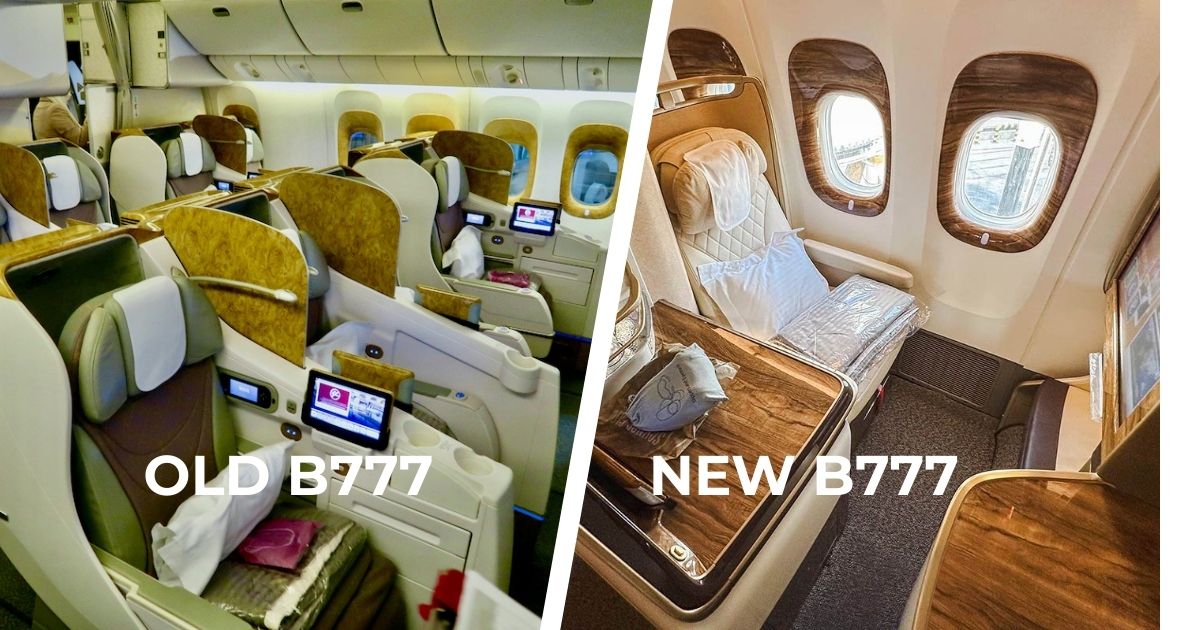
For well over a decade, Emirates 777 business class operated in a 2-3-2 configuration, seven seats across in each row, with a middle block of three seats in the centre of the cabin. That meant a significant proportion of passengers were seated in the middle section without direct aisle access.
The seats were angled-flat rather than fully lie-flat. They reclined to a deep angle and extended with a leg rest to approximately 69 inches, but they did not create a fully horizontal sleeping surface. For a six-hour sector, this was manageable. On a fourteen-hour overnight flight from Houston or Dallas to Dubai, the gap between an angled seat and a true flat bed is a significant one.
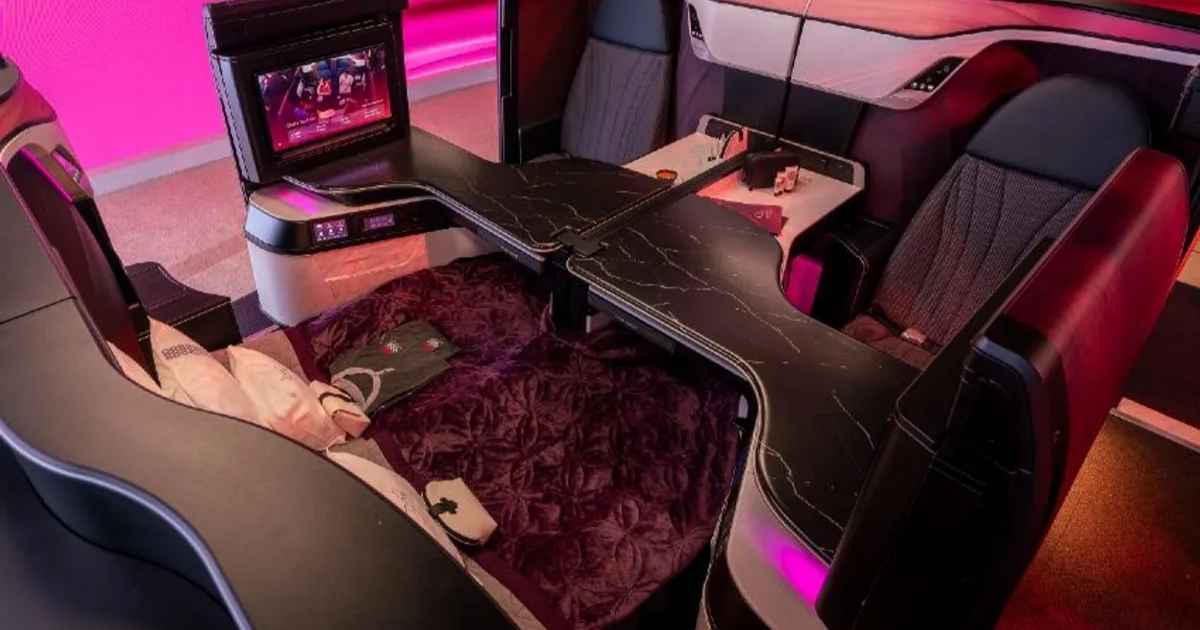
The product was not without its merits. The service standard was consistent with the rest of the Emirates network, the ICE entertainment system offered thousands of hours of content, multi-course dining and premium beverages were included, and the cabin aesthetics carried Emirates' signature gold and wood finishes. But the hardware was clearly behind the market, and the airline's competitors — particularly Qatar Airways — had moved decisively ahead on business class product quality.
For a long time, the 777 was a reason to actively seek out A380 routes from the US when booking Emirates.
The new Emirates 777 Business Class: What has changed
The retrofit programme Emirates launched in late 2024 represents one of the most significant cabin upgrades in the airline's history. The new 777 business class is not a refresh of the old product, it is an entirely different cabin.
Layout and Seat Configuration
The 2-3-2 layout is gone entirely. The new cabin operates in a staggered 1-2-1 configuration with 40 seats across two sections, a smaller forward mini-cabin of three rows directly behind first class, and a main cabin of seven rows behind it. Every single seat now has direct aisle access.
The staggered design creates natural separation between adjacent seats, reducing sightlines and improving the sense of personal space. There are no sliding doors, which means it does not match the most privacy-focused suite products on the market, but the improvement over the old layout is substantial.
Lie-Flat Beds
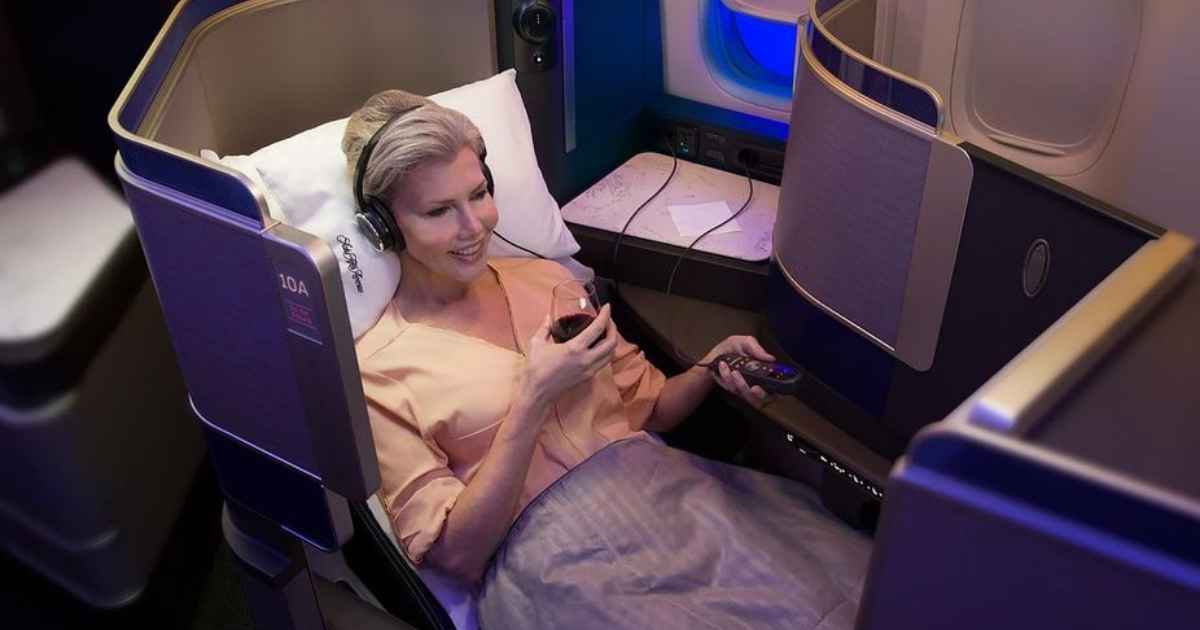
Every seat in the new cabin converts into a fully flat bed of 78 inches, a meaningful upgrade from the 69-inch angled position of the old product. The bed width is approximately 21 inches. Mattress pads, pillows, and blankets are provided as standard, and the seat is finished in champagne leather with detailed stitching that matches the aesthetic of the current A380 cabin.
For tall passengers or anyone who struggled to sleep on the older 777, the difference is immediately noticeable.
Entertainment and Connectivity
The new cabin carries 23-inch HD screens, some of the largest personal screens available in any business class product. The ICE entertainment system remains one of the most extensive in commercial aviation, with thousands of hours of content across films, TV, music, and podcasts. Bluetooth audio pairing is supported, removing the need for a wired connection to the seat.
Emirates is currently fitting Starlink satellite Wi-Fi across the refurbished 777 fleet, which will represent a significant improvement over the older OnAir Wi-Fi system previously installed. Once live, this will bring the 777 in line with the connectivity standard that travellers increasingly expect on long-haul premium routes.
The Personal Minibar
A personal minibar is fitted into the console of each new 777 business class seat, stocked with still and sparkling water and packaged snacks. It is a signature Emirates touch that feels premium on first encounter, though the contents are not refrigerated, which limits the practical usefulness compared to what the feature implies.
What the new 777 does not have
There is no onboard bar. The standing bar and social lounge remain exclusive to the A380. The new 777's social area is smaller and more limited in comparison, a design decision that reflects the physical constraints of a single-deck aircraft versus the A380 upper deck.
Amenity kits are not provided on daytime 777 flights, only on overnight sectors. Storage space in the seat console is also more limited than some competing products, with the minibar occupying space that could otherwise be used for personal items.
For passengers who value the A380 bar experience as a core part of their Emirates trip, the new 777 closes the gap on almost everything except that one feature.
Seat selection on the new Emirates 777 Business Class
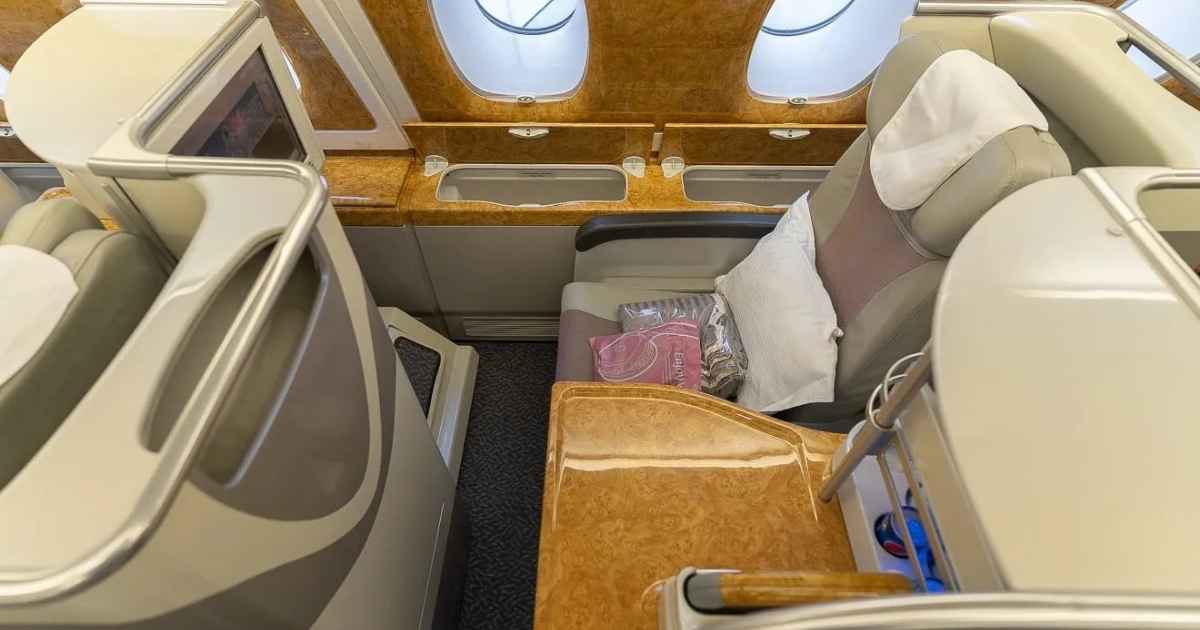
As with the A380, not all seats in the new 777 cabin are equal. The staggered 1-2-1 layout creates similar seat type distinctions - window-adjacent positions versus aisle-adjacent positions, and the same logic applies here.
Best seats in the new 777
Window seats in the forward mini-cabin (rows 1-3)
The forward section of three rows directly behind first class feels noticeably quieter and more exclusive. There is less through-traffic, fewer passengers nearby, and a generally calmer atmosphere. Window positions in these rows are the strongest choice for solo travellers on overnight flights.
Row 3 - seats 5A and 5K
These two seats sit at the rear of the forward mini-cabin and are the only seats in their row, one on each side of the aisle. This makes them effectively a private pair within a semi-enclosed space. They are widely considered among the best seats on the aircraft for passengers wanting maximum separation from other travellers. Note that these seats do not have a window, which is a trade-off worth knowing before selecting them.
Center seats E and F for couples
As with the A380, the staggered layout includes centre-section paired positions where two passengers can sit adjacent to each other. For couples or travel companions, these are the go-to choice.
Seats to approach with caution
Rows near bassinets
Some rows in the main cabin are designated for bassinet attachment for passengers travelling with infants. These rows are positioned in specific aisle positions and are worth identifying and avoiding on the seat map if you are a light sleeper.
Aisle-adjacent positions in the main cabin
Seats that sit closer to the aisle rather than the window offer less visual separation from passing cabin traffic and slightly less sense of privacy overall. They are perfectly functional seats, but when window-adjacent positions are available, they are the stronger choice.
Seats near the galley boundary
The transition point between the forward mini-cabin and the main cabin sits next to a galley divider. Seats immediately adjacent to this area can experience more noise during service preparation, particularly on early morning departures when crew activity begins before the cabin wakes.
How the retrofit programme is rolling out
Emirates launched the 777 retrofit programme in late 2024, and as of early 2025 the pace has been running at approximately one aircraft completed every two to three weeks. The airline has committed to retrofitting 81 of its 120 Boeing 777-300ERs, with the remainder of the fleet to be replaced progressively by incoming Boeing 777-9 and 777-8 aircraft from 2026 onwards.
The refurbished 777s are being deployed on an expanding list of routes worldwide. US cities currently receiving the new cabin product include Chicago, Boston, Dallas Fort Worth, Seattle, Miami, and Newark. This list is being extended as more aircraft complete the refit cycle.
The critical point for travellers booking today is that the retrofit is not complete. Over 75 percent of the 777 fleet still operated the older product as of late 2025. An Emirates 777 booking does not automatically mean a new cabin — it depends entirely on which specific aircraft is assigned to your route and departure date.
How to confirm which 777 you are flying
Emirates lists the scheduled aircraft type on booking pages, but the aircraft type alone does not tell you which cabin configuration is fitted. The 777 fleet is mid-refit, meaning the same aircraft type code can carry two entirely different business class products.
The most reliable approach is to verify the specific aircraft registration against Emirates' published seat maps, check aviation tracking resources that monitor fleet assignments, or work with a travel specialist who monitors these details as a standard part of the booking process.
Aircraft swaps also occur - particularly when an aircraft is pulled forward or delayed in the refit schedule. Confirming your aircraft assignment at the time of booking and again closer to departure is worth doing on any 777 route.
At BusinessTravel365, confirming aircraft configuration is a standard part of every booking we manage. We do not simply secure the fare, we verify what cabin you will be flying, and we stay on hand to flag any changes before you travel. If you want us to check what is operating on your route and what private fares are available, get in touch with our team.
Old vs new: Quick comparison
Seat layout
Old: 2-3-2, angled-flat, no direct aisle access from center seats
New: 1-2-1 staggered, fully lie-flat, direct aisle access from every seat
Bed length
Old: approximately 69 inches angled
New: 78 inches, fully flat
Screen size
Old: 17-inch screens on most aircraft
New: 23-inch HD screens throughout
Privacy
Old: Limited - particularly in the middle section
New: Improved through staggered design, though no sliding doors
Onboard bar
Old: Not available
New: Not available - this remains exclusive to the A380
Wi-Fi
Old: On Air system - slow and limited
New: Starlink is being progressively installed - significantly faster
Personal minibar
Old: Not available
New: Available at every seat
Is the new Emirates 777 Business Class worth flying?
For routes that do not operate on the A380, the new 777 cabin is a genuinely competitive choice. It brings Emirates' 777 in line with modern long-haul business class expectations, flat beds, direct aisle access, large screens, and a premium service experience throughout.
It is not a market-leading product. Competing airlines offer fully enclosed suites with sliding doors on comparable routes, and the absence of an onboard bar means the 777 experience, however improved, remains a step behind the A380 on atmosphere and overall premium feel.
But for an overnight flight from Chicago, Boston, or Dallas to Dubai, the new 777 delivers everything you need for a genuinely comfortable long-haul experience. Knowing it is the new cabin, not the old one, is the difference between boarding with confidence and being disappointed at the door.
- How to Book Emirates Business Class for Less: Private Fares Explained
Frequently Asked Questions
What is the difference between old and new Emirates 777 business class?
The old product used a 2-3-2 angled-flat layout where centre seats had no direct aisle access and beds did not fully flatten. The new cabin uses a 1-2-1 staggered layout with fully lie-flat 78-inch beds and direct aisle access from every seat — a fundamental upgrade on the two most important factors in long-haul business class.
How do I know if my Emirates 777 flight has the new business class?
Emirates lists the aircraft type at booking but does not always distinguish between refitted and non-refitted aircraft. The most reliable way is to check the seat map — the new cabin shows a 1-2-1 layout, while the old cabin shows a 2-3-2. Aircraft assignments can also change before departure, so it is worth rechecking closer to travel.
Does the new Emirates 777 have a bar like the A380?
No. The onboard bar and social lounge remains exclusive to the A380. The new 777 includes a smaller social area and a personal minibar at each seat, but it does not replicate the standing bar experience that is one of the A380's most distinctive features.
How many 777s have been retrofitted so far?
As of early 2026, Emirates has completed the retrofit on around 25 of its 120 Boeing 777-300ERs, with refits continuing at a rate of approximately one aircraft every two to three weeks. The airline aims to have the majority of the 777 fleet on the new cabin by late 2026, with remaining aircraft to be replaced by incoming 777-9 and 777-8 jets.
Is Emirates new 777 business class better than the A380?
The new 777 is significantly closer to the A380 experience than the old product, but the A380 still leads on space, cabin atmosphere, bed length, and the onboard bar. For routes that only operate on the 777, the new cabin is an excellent product. Where both aircraft types are available on similar routes, most frequent flyers still prefer the A380.
4284
URL Copied
Previous Blog
Emirates A380 Business Class: Best & Worst Seats to Pick
Next Blog
Qatar Airways QSuite Review: Everything You Need to Know
By providing my contact details and clicking on "REQUEST
QUOTE" I agree to be contacted for travel information via phone, text messages and
email. No purchase necessary. We respect your privacy
Thank You
for your request
We appreciate your interest. Your request is now being passed on to your dedicated travel consultant.
We will contact you shortly.