Please note that on our website, we use cookies. They are necessary for the functioning of our website and optimizing its performance. By clicking "Allow Cookies," you agree to our cookie policy. Learn
More
Available Now
(24/7, toll-free)
Looking for personalized itineraries or have questions about our services? We're here to
help.
Aer Lingus A330 vs A321XLR Business Class: Which Should You Book?
March 10, 202617 min Read Last updated on March 11, 2026
Business Class Airlines
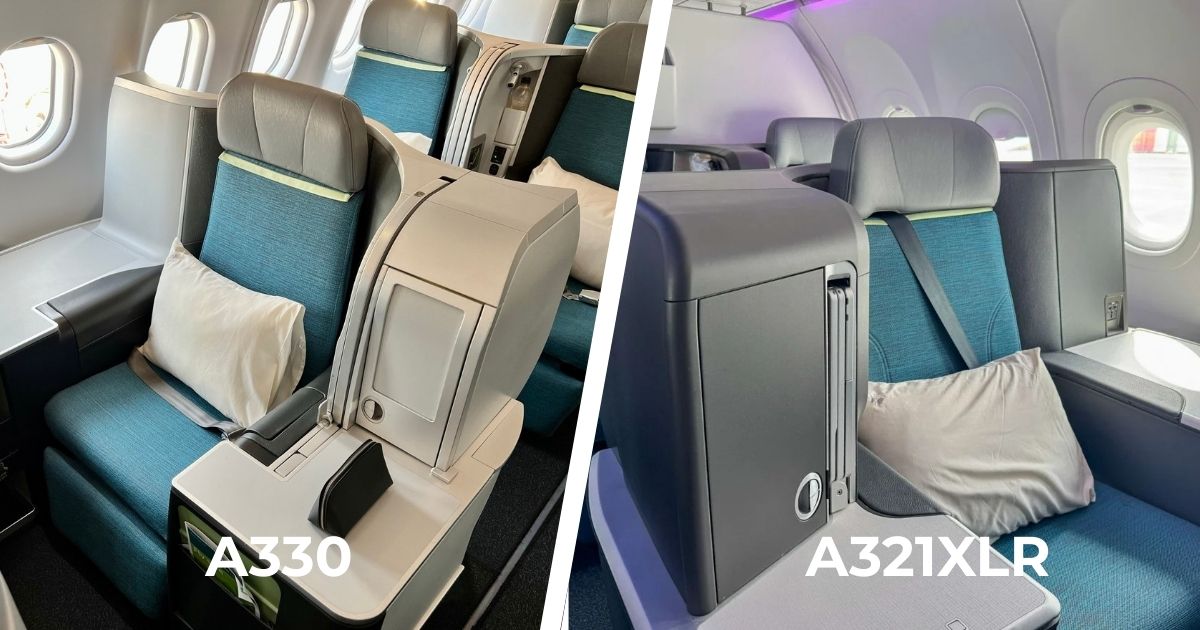
Aer Lingus operates two fundamentally different aircraft types on transatlantic routes from the US, the Airbus A330 widebody and the brand new Airbus A321XLR narrowbody. Both carry the same Business class name. Both use the same Thompson Vantage seat design. Both fly nonstop between the US and Dublin.
But the experience between them is different enough that it is worth understanding before you book, particularly around cabin size, seat width, aisle access, and the technology on offer. This guide covers every meaningful difference so you can make the right call for your specific route and travel style.
Why the aircraft type matters on Aer Lingus
Unlike the Emirates A380 vs 777 decision, where the gap between products can be dramatic, the Aer Lingus A330 and A321XLR are closer together than most travellers expect. The seat hardware is the same Thompson Vantage platform across both aircraft. The service standard, the dining, the bedding, and the Irish cabin atmosphere are consistent throughout the fleet.
The differences that do exist are real and worth knowing, but they are differences of degree rather than category. Neither aircraft is a bad choice, the question is which suits your specific situation better.
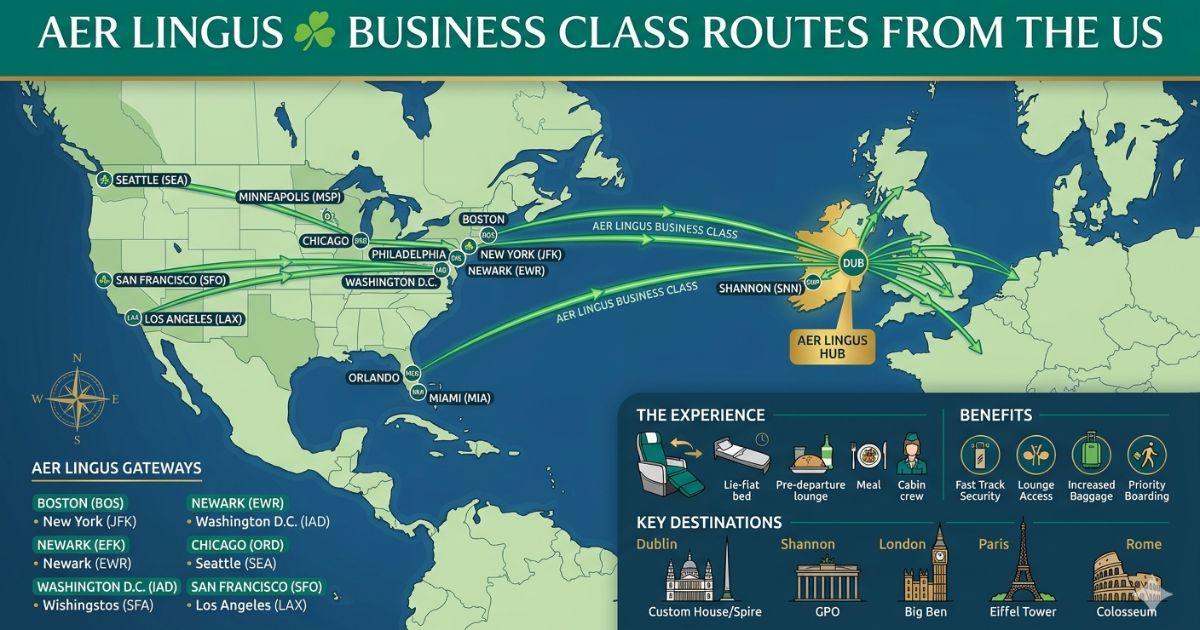
The A330 is Aer Lingus' widebody workhorse on high-frequency transatlantic routes. It operates from major US gateways including New York JFK, Boston, Chicago, Washington DC, Los Angeles, and other established city pairs where passenger demand justifies a larger aircraft.
Cabin size and layout
The A330-300, the most common A330 variant in the current Aer Lingus fleet, carries 30 business class seats, making it the largest business cabin in the transatlantic fleet. Most A330-300 aircraft have been updated to a predominantly 1-2-1 configuration, meaning the majority of passengers have direct aisle access.
The A330-200 carries 23 seats in a mixed 1-2-2 and 1-2-1 layout. Aisle access is less consistent on this configuration, with some window seats in even rows requiring passengers to step past a neighbour.
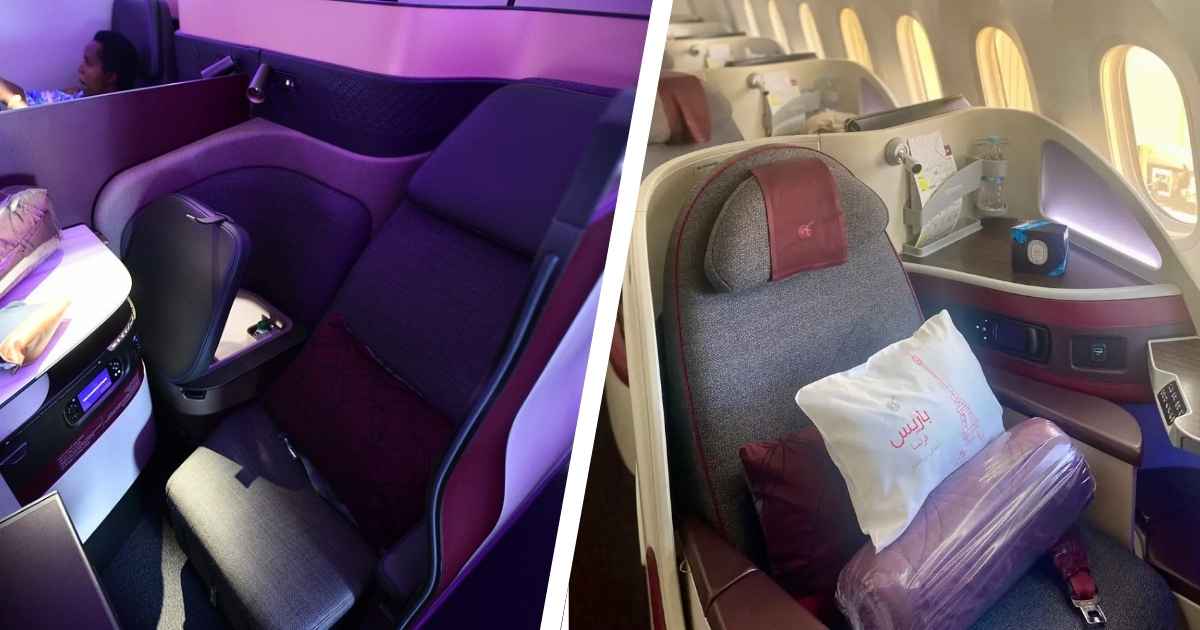
There is also a small number of older A330s in the fleet, ex-Qatar Airways aircraft that have not yet been fully retrofitted, that still carry a 2-2-2 business class layout throughout. These are the one configuration genuinely worth avoiding on Aer Lingus. The seat product is noticeably older, aisle access is poor from window positions, and the cabin atmosphere is a step down from everything else in the fleet. The seat map will show a 2-2-2 layout throughout if your flight is on one of these aircraft, check before booking.
Seat Width and Space
The A330 is a twin-aisle widebody, and that physical reality translates directly into the cabin. Seats on the A330 are approximately 22 inches wide, meaningfully wider than the narrowbody alternative, and the greater fuselage width creates more shoulder room and a more spacious feel throughout.
Throne seats on the A330-300 are at positions 3K, 5K, and 7K. These window alcove seats sit flush against the fuselage with storage on both sides and no adjacent seatmate, the most private individual seat configuration in the cabin.
Entertainment and Connectivity
The A330 fleet carries 16-inch HD touchscreens. Wi-Fi is complimentary for business class passengers and sufficient for email, messaging, and light browsing. Aer Lingus is rolling out Starlink-powered Wi-Fi across the A330 fleet through 2026, which will bring a significant improvement to connection speed and reliability once complete.
The A321XLR: The narrowbody that does widebody Work
The A321XLR is the newest aircraft in the Aer Lingus fleet, with the first examples delivered in late 2024. It is the most technologically advanced narrowbody aircraft ever built for transatlantic operations, with a range of approximately 4,700 nautical miles, enough to connect Dublin nonstop with secondary US markets that could never sustain the passenger volumes of a widebody.
That range capability is the reason Nashville, Indianapolis, Minneapolis, and the new Raleigh-Durham service launching in April 2026 exist on the Aer Lingus network. For travellers in these cities, the A321XLR is not a compromise, it is the only aircraft making nonstop transatlantic business class travel from their home airport possible at all.
Cabin size and layout
The A321XLR carries 16 business class seats in five rows, alternating between a 2-2 layout in rows 2, 4, and 6, and single throne seat rows at rows 3 and 5. The four throne seats, positions 3A, 3K, 5A, and 5K, are the standout positions in the cabin, offering private window alcoves with storage on both sides and no neighbour under any circumstances.
The 12 remaining seats in the 2-2 rows come with a trade-off. Approximately 60 percent of the cabin has direct aisle access. The remaining 40 percent — window seats in the paired rows, do not have direct aisle access, meaning passengers in these positions either need to step past a seatmate or ask them to move. On a seven-hour overnight flight, this is a genuine practical consideration for light sleepers and anyone who gets up during the night.
The cabin is noticeably smaller than the A330, 16 seats versus 30. For travellers who value a quieter, more intimate cabin environment, this can actually be an advantage. Service tends to feel more personal on the A321XLR simply because there are fewer passengers to attend to, and the smaller cabin creates a less busy atmosphere throughout.
Seat width and the narrowbody caveat
This is the most important hardware difference between the two aircraft. The A321XLR seats are approximately 20 inches wide, roughly two inches narrower than the A330 equivalent. That difference is noticeable when lying flat, particularly for broader-shouldered passengers.
In the throne seats, the narrower width is more pronounced. The throne design means you are in one seat with no armrest to lower for more width. This means you sleep more tightly than a widebody. For the two seats in a row, the armrest between the two seats can be lower, making the space bigger. This only works if both seats are used by the same people.
For taller travellers, bed length is consistent across both aircraft. The A321XLR converts to a 77-inch flat bed, one or two inches shorter than the A330's equivalent, but comfortable for most passengers including those over six feet.
Entertainment and Connectivity
This is where the A321XLR pulls definitively ahead. The new aircraft carries 18-inch 4K screens with Bluetooth audio pairing, a meaningful step up from the 16-inch HD screens on the A330 fleet. The content library on the XLR is also larger, with a noticeably broader selection of films and TV across genres.
Wi-Fi on the A321XLR currently requires a purchase of around €20 for full-flight browsing — unlike the complimentary Wi-Fi on the A330. However, Aer Lingus has confirmed Starlink-powered connectivity rolling out across the XLR fleet through 2026, which will bring free, streaming-capable Wi-Fi to the aircraft once installed. This is an evolving situation and worth checking at the time of booking.
Overhead bin space on the A321XLR is a genuine surprise. The bins are large enough to accommodate full-size roller bags without gate-checking, a practical advantage on an aircraft that might otherwise feel compact.
A330 vs A321XLR: Direct comparison
Cabin size
A330-300: 30 seats. A321XLR: 16 seats. The A330 offers more seat choice and variety. The A321XLR offers a quieter, more intimate environment.
Seat width
A330: approximately 22 inches. A321XLR: approximately 20 inches. The A330 is meaningfully wider, a relevant difference for sleeping comfort on overnight sectors.
Bed length
A330: approximately 78 to 79 inches. A321XLR: approximately 77 inches. Closely matched, with the A330 marginally ahead.
Direct aisle access
A330-300 (updated configuration): most seats. A321XLR: approximately 60 percent of seats. The throne seats on both aircraft always have direct aisle access. Paired window seats on the A321XLR do not.
Throne seats
A330-300: 3 throne seats (3K, 5K, 7K). A321XLR: 4 throne seats (3A, 3K, 5A, 5K). The XLR offers more throne seat options per cabin despite having the smaller overall seat count.
Entertainment screens
A330: 16-inch HD. A321XLR: 18-inch 4K with Bluetooth audio. The XLR wins clearly on technology.
Wi-Fi
A330: complimentary. A321XLR: currently purchased separately at around €20, with free Starlink rolling out through 2026.
Cabin atmosphere
A330: larger, more spacious widebody feel. A321XLR: smaller, quieter, more personal service dynamic.
Soft product
Identical across both aircraft, same dining, same bedding, same service standards, same amenity kits on overnight sectors.
Who should book which aircraft?
Book the A330 if:
You are departing from a major US gateway, New York, Boston, Chicago, Washington, DC, or Los Angeles, where the A330 is the primary aircraft. You are a broader-shouldered traveller for whom the extra two inches of seat width on overnight sectors makes a material difference. You want the widest possible seat selection including three throne options on the A330-300. You prefer complimentary Wi-Fi without needing to track the Starlink rollout status.
Book the A321XLR if:
You are departing from a secondary US market where the XLR is the only aircraft offering nonstop business class, Nashville, Indianapolis, Minneapolis, Raleigh-Durham. You are a solo traveller who can secure a throne seat and wants a quieter, more intimate cabin with superior entertainment technology. You value the larger screens and Bluetooth audio for a long overnight flight. You are comfortable with the narrower seat width and slightly shorter bed in exchange for a more modern onboard technology experience.
The most important practical point:
If you are booking either aircraft and travelling solo, securing a throne seat should be your first priority. On the A330-300, three throne seats go quickly on popular routes. On the A321XLR, four throne seats are available but the smaller overall cabin means competition for them is proportionally just as high. Book early and select your seat at the time of booking.
The older A330s in the Aer Lingus fleet, ex-Qatar Airways aircraft that have not yet been retrofitted, still carry a 2-2-2 business class layout. This is a categorically different and inferior product compared to everything else in the fleet. Window seats have no direct aisle access. The cabin feels cramped by modern standards, and the overall experience is a step down from what Aer Lingus offers elsewhere.
The seat map makes it easy to identify these aircraft, a 2-2-2 layout throughout business class with no throne seat positions visible. If your flight shows this configuration, it is worth checking whether an alternative departure date or aircraft assignment is available before confirming.
Does the route determine the aircraft?
In most cases, yes. The A330 is assigned to high-frequency, high-demand routes from major US gateways where passenger volumes justify the larger aircraft. The A321XLR is deployed on thinner routes, lower-demand city pairs and secondary markets, mnbv where a widebody would not fill economically.
In practice this means that for travellers flying from established US gateways on popular routes, the A330 is the default experience. For travellers flying from newer or smaller US markets, the A321XLR is both the available option and the enabling factor that makes nonstop service from those cities possible at all.
Some routes operate both aircraft types depending on the day, season, or schedule. Checking the specific aircraft assigned to your flight at the time of booking — and monitoring for any changes, is the most reliable approach.
At BusinessTravel365, confirming aircraft type, verifying cabin configuration, and securing throne seats where available are standard parts of how we manage every Aer Lingus booking. If you want to check what is available on your route and what private fares apply, get in touch with our team
- US Preclearance at Dublin & Shannon: What It Is & Why It Matters
- Aer Lingus Business Class Lounge Guide: Dublin, Shannon & US Airports
- How to Book Aer Lingus Business Class for Less: Private Fares & Avios Explained
- Aer Lingus vs British Airways Business Class: Which Is Better for Transatlantic Travel?
Frequently Asked Questions
Is Aer Lingus A321XLR business class as good as the A330?
For most practical purposes, yes, the seat hardware, the dining, the service, and the bedding are consistent across both aircraft. The A330 offers a wider seat and a larger cabin with more seat choice. The A321XLR counters with superior entertainment technology, a more intimate cabin atmosphere, and more throne seat positions proportionally. The right choice depends on your route, your seat preference, and how much the seat width difference matters to you for sleeping.
Are Aer Lingus A321XLR seats narrower than the A330?
Yes. A321XLR business class seats are approximately 20 inches wide compared to approximately 22 inches on the A330. The difference is most noticeable when lying flat on overnight sectors. Broader-shouldered travellers and those who prioritise maximum sleeping width should factor this into their choice.
Does the A321XLR have lie-flat seats?
Yes. The A321XLR has a Thompson Vantage seat in all 16 business class seats. It turns into a fully flat bed of about 77 inches. This is about one to two inches shorter than the A330, but it is still good enough for most travelers.
What are throne seats on the Aer Lingus A321XLR?
Throne seats are single window positions at rows 3 and 5, specifically 3A, 3K, 5A, and 5K. These are individual alcove seats with no adjacent seatmate, storage on both sides, and full window access. They are the most sought-after seats in the A321XLR cabin and should be selected as early as possible after booking.
Why does Aer Lingus use a narrowbody for transatlantic flights?
The A321XLR has a range of approximately 4,700 nautical miles, enough to connect Dublin nonstop with US cities that cannot fill a widebody aircraft economically. Secondary markets like Nashville, Indianapolis, Minneapolis, and Raleigh-Durham now have nonstop transatlantic business class access precisely because the XLR makes these routes commercially viable without requiring the passenger volumes of an A330 or larger aircraft.
Is Wi-Fi free on both Aer Lingus aircraft types?
Currently, Wi-Fi is complimentary for business class passengers on A330 aircraft. On the A321XLR, Wi-Fi requires a purchase of around €20 for full-flight browsing at present. Aer Lingus is rolling out Starlink-powered free Wi-Fi across both fleet types through 2026, which will standardise complimentary connectivity once the installation programme is complete.
4710
URL Copied
Previous Blog
Qatar Airways QSuite vs Standard Business Class: What Is the Difference?
Next Blog
Aer Lingus Business Class Routes from the US: Full 2026 Guide
By providing my contact details and clicking on "REQUEST
QUOTE" I agree to be contacted for travel information via phone, text messages and
email. No purchase necessary. We respect your privacy
Thank You
for your request
We appreciate your interest. Your request is now being passed on to your dedicated travel consultant.
We will contact you shortly.