Please note that on our website, we use cookies. They are necessary for the functioning of our website and optimizing its performance. By clicking "Allow Cookies," you agree to our cookie policy. Learn
More
Available Now
(24/7, toll-free)
Looking for personalized itineraries or have questions about our services? We're here to
help.
Aer Lingus Business Class Routes from the US: Full 2026 Guide
March 10, 202619 min Read Last updated on March 11, 2026
Business Class Airlines
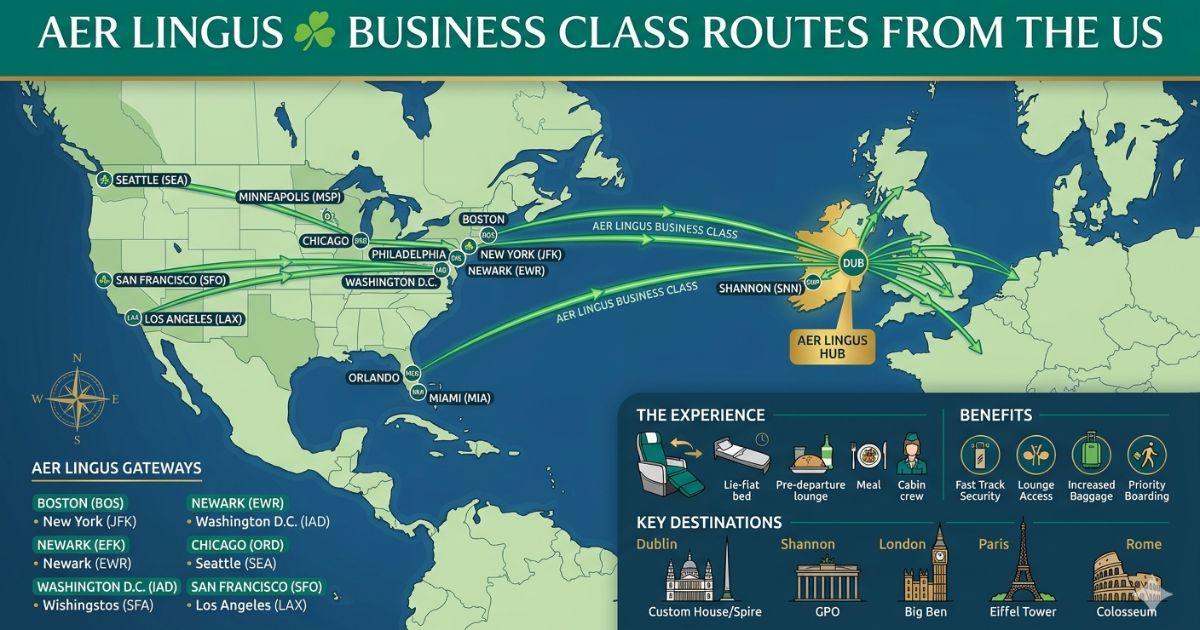
Aer Lingus now serves a record 20 US airports with nonstop service to Ireland, and the network is still growing. It started as a few East Coast routes, but now it's one of the most interesting transatlantic routes in premium aviation. The Airbus A321XLR has opened up new city pairs that no European carrier has ever served nonstop before.
For US travelers looking for a fully lie-flat business class flight to Europe, Aer Lingus in 2026 has more departure options, more aircraft types, and cheaper prices than ever before. This guide covers every US route, the aircraft assigned to each, flight frequencies, and what the Dublin connection means for onward travel across Europe.
How Aer Lingus routes from the US work
Every Aer Lingus nonstop flight from the US operates to Dublin Airport or Shannon Airport in Ireland. Dublin is the primary hub — connecting passengers to over 100 European destinations through the short-haul network. Shannon is a second choice for some East Coast flights. It has the same US airport as Dublin and is quieter and less crowded.
Unlike Gulf airlines, which only fly between one hub and many other hubs, Aer Lingus mainly flies between one US city and Ireland. This means your transatlantic sector is a single nonstop flight, not a connection through a third city, regardless of which US airport you depart from.
For travelers going to the UK or Europe, the Dublin connection adds a short trip of one to three hours to most big European cities. Aer Lingus' short-haul network covers the key European destinations, London, Paris, Amsterdam, Frankfurt, Rome, Madrid, and dozens of others, all on a single ticket when booked together.
New York JFK is Aer Lingus' busiest and most established US gateway. The third daily summer service, with a late night departure, starts in summer 2026. This gives New York travelers great flexibility, including the option to work a full day and still make an overnight transatlantic departure. The A330-300, which can hold up to 30 business class seats, always flies on this route. This makes it one of the most reliable sources of throne seats in the network.
Boston - Dublin
Aircraft: Airbus A330-300 / A321XLR (seasonal mix)
Frequency: Up to three daily flights in peak summer 2026
Flight time: Approximately 6 hours eastbound, 7 hours westbound
Boston is Aer Lingus' second-busiest US gateway and the one with the strongest Irish-American community connection. The additional third daily summer service in 2026 mirrors the JFK expansion. Boston also has Shannon service on some days. This is a good choice for travelers who want a quieter experience before their trip or who are going to the west of Ireland.
Chicago O'Hare - Dublin
Aircraft: Airbus A330-300
Frequency: Daily, year-round, additional summer frequency
Chicago is the primary Midwest gateway and one of the strongest performing routes in the Aer Lingus US network. The A330-300 operates year-round with a consistent business class offering. Aer Lingus business class passengers can use the lounge at O'Hare with the Oneworld partnership. This is one of the best US departure lounges in the network.
Washington DC is a key gateway for government, diplomatic, and international business travellers. The route operates year-round and is one of the established Aer Lingus East Coast services with consistent business-class availability.
Los Angeles is Aer Lingus' primary West Coast gateway and the longest nonstop route in the US network at over ten hours each way. The A330-300 operates this route consistently, and at this sector length, the wider seat and larger cabin of the widebody make a noticeable difference in overnight comfort. LA is also the departure point for Aer Lingus' longest-haul published business class fares, which tend to sit at higher price points than East Coast equivalents.
Philadelphia - Dublin
Aircraft: Airbus A321XLR / A321neo LR
Frequency: Daily in peak season, high frequency year-round
Philadelphia has been one of Aer Lingus' more underrated US gateways, positioned to serve both Philadelphia residents and travellers from across Pennsylvania and the mid-Atlantic region who want to avoid the congestion of JFK and Newark. The A321XLR operates on this route, bringing the newer cabin technology and four throne seats to a high-frequency service.
Orlando - Dublin
Aircraft: Airbus A321XLR / A321neo LR
Frequency: Daily in summer 2026, high-frequency year-round
Flight time: Approximately 8 hours and 30 minutes eastbound. 9 hours westbound
Orlando will open every day in summer 2026. This is a big increase for Florida visitors. It shows that more and more Irish and European visitors are using Orlando as a way to get into the US. The A321XLR operates on this route and the longer sector length makes the lie-flat bed a particularly valued feature.
San Francisco is Aer Lingus' second West Coast gateway. The route operates seasonally in peak summer and is served by the A330-300. It is one of the longest transatlantic sectors in the network, and it is the best choice for the widebody cabin.
Seattle is one of the newer US gateways in the Aer Lingus network, operated by the A321XLR. The Pacific Northwest is becoming a popular place to travel to Europe. The XLR's range makes it possible to travel to Europe without having to travel long distances.
Hartford is one of Aer Lingus' most unusual but practical US gateways. It is designed to serve New England travelers who want to avoid the crowds of Boston Logan and New York's JFK. For Connecticut, western Massachusetts, and upstate New York travellers, Hartford represents a meaningfully more convenient departure option with the same product.
Nashville - Dublin
Aircraft: Airbus A321XLR
Frequency: Five weekly flights in 2026, up from four in 2025
Flight time: Approximately 8 hours and 30 minutes eastbound. 9 hours westbound
Nashville launched in 2025 as one of the first A321XLR-enabled routes in the Aer Lingus US network. The frequency increase to five-weekly in 2026 reflects strong demand from a market that previously had no nonstop transatlantic business class option at all. For Tennessee, Kentucky, and the broader Mid-South region, Nashville provides access to Dublin and onward to Europe without a domestic positioning flight.
Indianapolis - Dublin
Aircraft: Airbus A321XLR
Frequency: Five weekly flights in 2026, up from four in 2025
Indianapolis launched alongside Nashville in 2025. The route serves a large area across Indiana, Ohio, and the Midwest. This area used to have no direct business-class flights to the United States from the East Coast. The frequency increase to five-weekly in 2026 reflects the same pattern of strong initial demand driving rapid capacity growth.
Minneapolis resumed service after a multi-year gap and is now part of the A321XLR-enabled secondary market expansion. The route serves the upper Midwest and the large Scandinavian-American community in Minnesota. Many of these people use Dublin as a stop on their way to Northern Europe.
Denver - Dublin
Aircraft: Airbus A321XLR
Frequency: Seasonal
Flight time: Approximately 9 hours eastbound, 9 hours westbound
Denver is one of the newer Aer Lingus US stations. It serves the Mountain West and connects the growing population of the area to Dublin and Europe without a domestic connection. The A321XLR operates this seasonal route.
Las Vegas - Dublin
Aircraft: Airbus A321XLR
Frequency: Seasonal
Flight time: Approximately 10 hours eastbound, 10 hours westbound
Las Vegas is a new addition to the Aer Lingus US network. It is one of the most unique cities in transatlantic aviation. The route reflects both leisure demand and the significant convention and events market that moves through Las Vegas year-round. For Nevada and surrounding western states, it provides a nonstop transatlantic option that did not previously exist.
Raleigh-Durham is one of the most significant new route launches in the 2026 Aer Lingus US expansion. The Research Triangle is one of the fastest-growing technology and life sciences hubs in the US, with a large international professional community that has historically had to connect through Washington DC, New York, or Charlotte for transatlantic travel. The A321XLR makes nonstop service viable on what is a thinner route by transatlantic standards.
Pittsburgh is the newest addition to the Aer Lingus US network, launching at the end of May 2026 in time for peak summer. It covers approximately 2,993 nautical miles, a route that has never been served nonstop before. Pittsburgh is a gateway for western Pennsylvania, eastern Ohio, and West Virginia. Dublin is the fourth-largest transatlantic market by passenger volume. Four weekly frequencies at launch reflect a cautious but commercially grounded start for an untested nonstop market.
Shannon routes from the US
Shannon Airport offers US preclearance alongside Dublin and serves as a secondary Irish gateway for select East Coast routes. Aer Lingus flies from Boston to Shannon all the time on some flights. It also flies from New York and other East Coast cities sometimes, depending on the weather or schedule.
Shannon is a significantly less congested airport than Dublin and the preclearance facility is typically faster and less busy. For travellers heading to the west of Ireland, Galway, Clare, Limerick, Kerry, Shannon is the more practical arrival point. For those connecting onward to European destinations, Dublin's larger short-haul network makes it the stronger hub choice.
For everything you need to know about US preclearance at both airports: US Preclearance at Dublin & Shannon: What It Is & Why It Matters
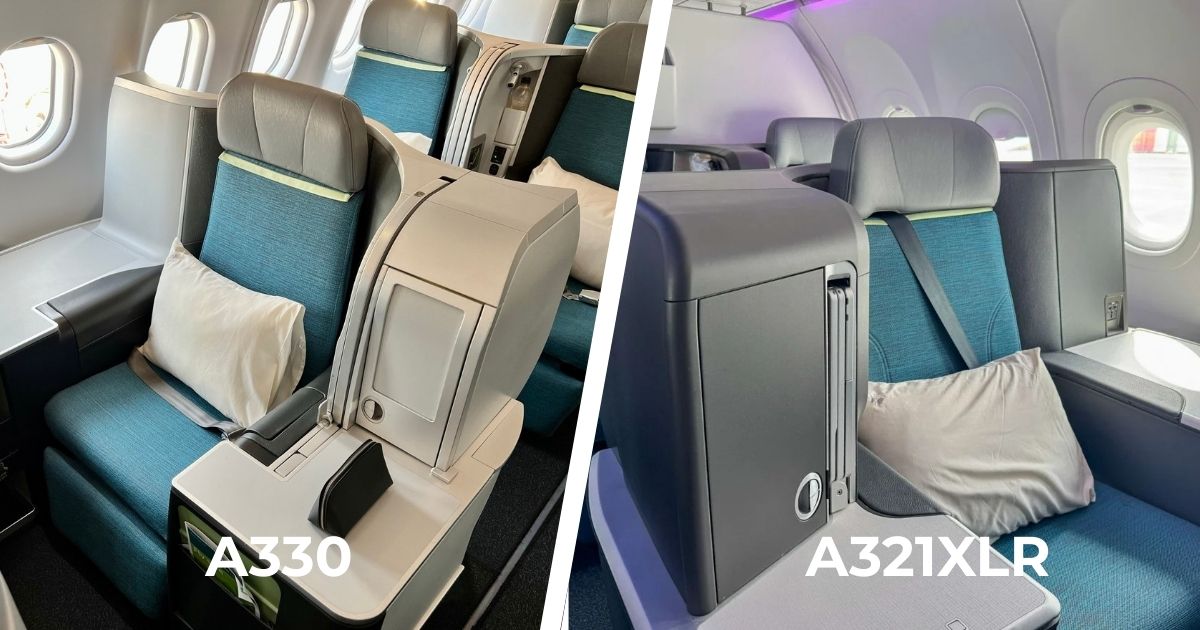
Aircraft assignments: A330 vs A321XLR by Route
Understanding which aircraft operates your specific route matters for seat width, cabin size, and entertainment technology. Here is the general pattern as of 2026.
A330-300 routes: New York JFK, Boston (primary service), Chicago, Washington DC (shared), Los Angeles, San Francisco. These are the highest-frequency, highest-demand routes where widebody economics work.
A321XLR and A321neo LR routes: Philadelphia, Orlando, Seattle, Hartford, Nashville, Indianapolis, Minneapolis, Denver, Las Vegas, Raleigh-Durham, Pittsburgh. These are the secondary markets and thinner routes where the XLR's lower operating cost and extended range make nonstop service viable.
Some routes operate a mix of both aircraft types depending on the season and schedule. Narrowbodies now account for over 50 percent of Aer Lingus peak summer transatlantic departures in 2026 — a significant shift from 41 percent in 2025, reflecting the pace of the A321XLR fleet expansion.
Aer Lingus' short-haul network from Dublin covers over 100 destinations across the UK and Europe, all available on a single connecting ticket when booked together with the transatlantic sector. Key onward connections include:
United Kingdom: London Heathrow, London City, Manchester, Edinburgh, Birmingham, Bristol, Glasgow, and more.
Western Europe: Paris, Amsterdam, Frankfurt, Rome, Milan, Barcelona, Madrid, Lisbon, Zurich, and dozens of other European cities.
Southern Europe and Islands: Alicante, Malaga, Palma, Tenerife, Fuerteventura, Lanzarote, Gran Canaria, popular leisure destinations with direct connections from Dublin.
Northern Europe: Copenhagen, Stockholm, Oslo (new 2026), and Scandinavian cities reachable within two hours of Dublin.
For US travellers heading to the UK, the Aer Lingus connection through Dublin is particularly competitive. London Heathrow, Manchester, and Edinburgh are all within 75 to 90 minutes of Dublin and are among the most frequently served routes in the short-haul network.
How much does Aer Lingus Business Class cost from the US?
Aer Lingus consistently offers some of the most competitive published business class fares on transatlantic routes. Round-trip published fares from East Coast cities including New York, Boston, and Washington DC typically range from $2,200 to $4,500 depending on season and how far in advance you book. Off-peak fares in January, February, and November have been observed as low as $1,900 round-trip from New York, exceptional value for a fully lie-flat transatlantic product.
West Coast routes from Los Angeles and San Francisco carry higher base fares at $3,500 to $6,000 round-trip on published rates, reflecting the longer sector lengths.
A private fare market also exists below these already-competitive published prices. Airlines work with consolidators who negotiate unpublished rates that are never visible on any public booking platform. For Aer Lingus specifically, where published fares are already among the most accessible in transatlantic business class, a private consolidator fare can make an already strong value proposition even more compelling.
At BusinessTravel365, we access these private fares for our clients across all Aer Lingus US gateway cities. We verify aircraft type and cabin configuration, secure the throne seat positions where available, handle the full booking, and stay on hand throughout travel. If you want to check what is available on your route, get in touch with our team, and we will come back to you with options.
For more on how private fares and Avios redemptions work for Aer Lingus bookings: How to Book Aer Lingus Business Class for Less: Private Fares & Avios Explained
- US Preclearance at Dublin & Shannon: What It Is & Why It Matters
- Aer Lingus Business Class Lounge Guide: Dublin, Shannon & US Airports
- How to Book Aer Lingus Business Class for Less: Private Fares & Avios Explained
- Aer Lingus vs British Airways Business Class: Which Is Better for Transatlantic Travel?
- Best Business Class Airlines from the US to Europe in 2026
Frequently Asked Questions
How many US cities does Aer Lingus fly from in 2026?
Aer Lingus now serves a record 20 US airports with nonstop service to Dublin or Shannon. Established gateways include New York JFK, Boston, Chicago, Washington DC, Los Angeles, Philadelphia, Orlando, San Francisco, Seattle, Hartford, Nashville, Indianapolis, Minneapolis, Denver, and Las Vegas. New routes launching in 2026 include Raleigh-Durham in April and Pittsburgh in May.
Does Aer Lingus fly business class from all US cities?
Yes. Business class with fully lie-flat seats is available on all Aer Lingus transatlantic routes from every US gateway city. Aircraft vary between the Airbus A330-300 on major high-frequency routes and the A321XLR on secondary market routes, but the lie-flat seat product is consistent across both.
Which Aer Lingus US routes use the A330?
The A330-300 operates primarily on high-frequency, high-demand routes: New York JFK, Boston, Chicago, Washington DC, Los Angeles, and San Francisco. These are the routes where widebody economics and larger cabin capacity are justified by passenger volumes.
Which Aer Lingus US routes use the A321XLR?
The A321XLR operates on secondary market routes including Philadelphia, Orlando, Seattle, Hartford, Nashville, Indianapolis, Minneapolis, Denver, Las Vegas, Raleigh-Durham, and Pittsburgh. These routes are commercially viable specifically because of the XLR's lower operating costs and extended range.
Can I fly Aer Lingus business class from Shannon?
Yes. Shannon Airport operates as a secondary Irish gateway with US preclearance alongside Dublin. Nonstop service from Shannon is available from select East Coast cities including Boston on certain schedules. Shannon offers a quieter, less congested preclearance experience and is the more practical arrival point for travellers heading to the west of Ireland.
How does the Dublin connection work for onward European travel?
Aer Lingus operates over 100 short-haul routes from Dublin to destinations across the UK and Europe. When booked on a single ticket, the transatlantic business class experience connects seamlessly to onward European sectors — covering London, Paris, Amsterdam, Frankfurt, Rome, Madrid, and dozens of other cities within one to three hours of Dublin.
Is Aer Lingus business class from secondary US cities the same product as from New York?
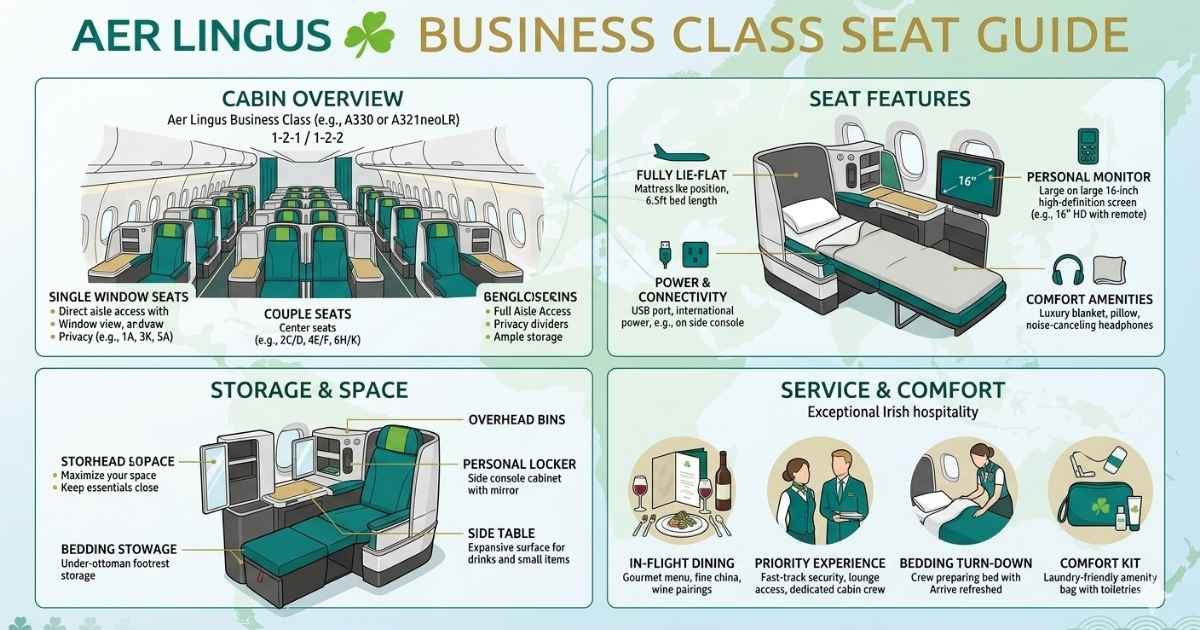
Yes. The business class seat hardware, Thompson Vantage lie-flat seat is the same across both the A330 and A321XLR fleets. Seat width and cabin size differ between aircraft types, but the service standard, dining quality, bedding, and amenity kit are consistent across all routes regardless of departure city.
9465
URL Copied
Previous Blog
Aer Lingus A330 vs A321XLR Business Class: Which Should You Book?
Next Blog
Aer Lingus Business Class Seat Guide: Throne Seats, A330 vs A321 & Best seats to pick
By providing my contact details and clicking on "REQUEST
QUOTE" I agree to be contacted for travel information via phone, text messages and
email. No purchase necessary. We respect your privacy
Thank You
for your request
We appreciate your interest. Your request is now being passed on to your dedicated travel consultant.
We will contact you shortly.